

How AI Notetakers Strengthen High-Performance Sales Operations

Heading 1
Heading 2
Heading 3
Heading 4
Heading 5
Heading 6
Lorem ipsum dolor sit amet, consectetur adipiscing elit, sed do eiusmod tempor incididunt ut labore et dolore magna aliqua. Ut enim ad minim veniam, quis nostrud exercitation ullamco laboris nisi ut aliquip ex ea commodo consequat. Duis aute irure dolor in reprehenderit in voluptate velit esse cillum dolore eu fugiat nulla pariatur.
Block quote
Ordered list
- Item 1
- Item 2
- Item 3
Unordered list
- Item A
- Item B
- Item C
Bold text
Emphasis
Superscript
Subscript

How AI Notetakers Strengthen High-Performance Sales Operations
Join us on November 6th as Mr. Yash Mishra, Product Manager, Fatakpay, reveals the precise strategies that eliminates the speed trap and guarantees a 30% conversion boost.
More calls, more stakeholders, and more pressure to capture important information have changed how sales teams operate. Conversations now move faster than manual notes could ever keep up with. Over time, AI notetakers moved from optional support to something sales teams rely on every day, especially when their outputs flow directly into the CRM to shape follow-ups and forecasts.
They’re becoming more widespread because they remove friction in key moments. This article looks at how the shift occurred, how teams build these workflows today, and where things can break if they’re not designed carefully.
What is an AI meeting notetaker?
An AI meeting notetaker records the meeting, transcribes the conversation, and turns that raw dialogue into structured outputs like summaries, action items, and deal signals. As sales moved remote and the number of conversations increased, manual notes stopped scaling and relying on memory became risky.
The shift accelerated when meeting outputs started flowing into systems of record like Corefactors CRM. Once conversations became usable sales data tied to deals, stages, and follow-ups, AI notetakers moved from convenience to infrastructure. Rather than adopting another tool, sales teams were operationalizing conversation data across their workflow.
In practice, the workflow functions as a pipeline. A recording method captures the meeting, often using infrastructure like Teams transcription API in Microsoft Teams environments to generate accurate transcripts with speaker context. Language models then structure that data so it can be routed into CRMs, dashboards, or internal tools, where it actually supports follow-through and decision making.
Why AI notetakers drive results inside the CRM
AI notetakers create the most value when they’re tightly connected to the CRM, not sitting alongside it. When conversation data flows directly into deal records, timelines, and fields, teams stop relying on memory and start working from shared context.
This improves follow-through and visibility at the same time. Reps move faster because notes, action items, and next steps are already in place. Managers get a clearer view of deals because updates reflect what actually happened on calls, not post-call interpretation.
Over time, this connection compounds. CRM data stays cleaner, risks are flagged earlier, and forecasts become more reliable. The advantage doesn’t come from transcription alone, but from turning conversations into structured inputs that support decisions across the sales workflow.
Core sales use cases teams rely on every day
Most sales teams don’t think in terms of AI features. They think in terms of what needs to be done after a call. That’s where AI notetakers earn their keep.
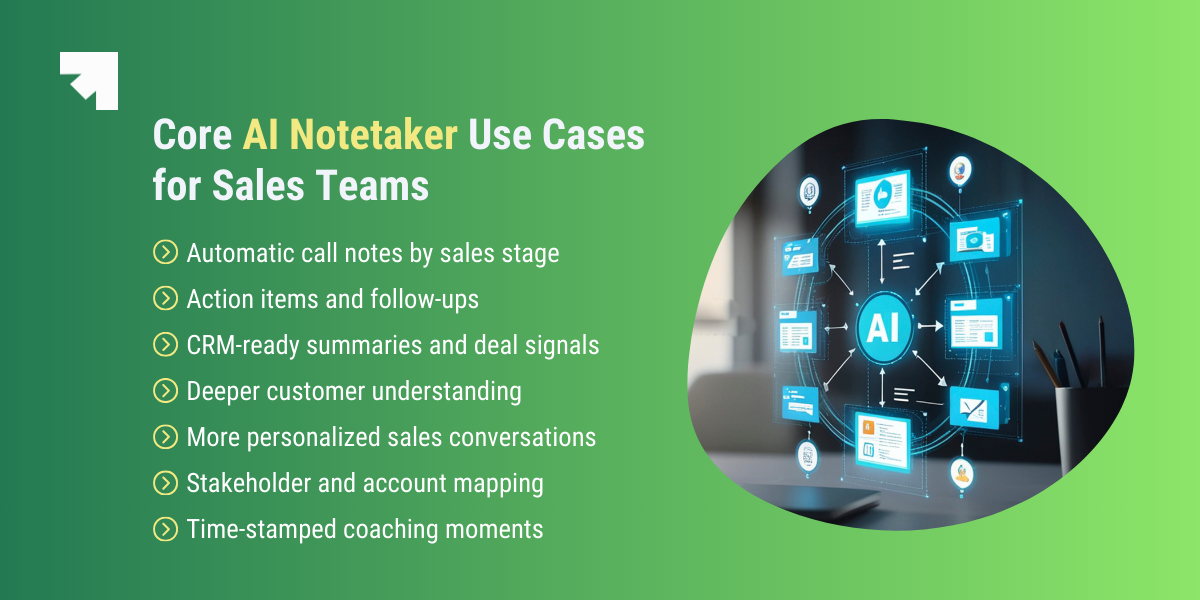
Automatic call notes by sales stage
Instead of generic summaries, teams rely on clean write-ups mapped to sales stages, so a discovery call reads differently from a late-stage deal review. Those notes become the baseline for everything that follows.
Action items and follow-ups
Clear next steps pulled directly from the conversation reduce dropped balls and keep momentum moving. When structured correctly, they land directly in the CRM deal timeline instead of living in a separate notes doc.
CRM-ready summaries and deal signals
Notes formatted for fields, stages, and records keep deal data organized without adding admin work. This structure also surfaces early signal detection like missed stakeholders, vague commitments, or hesitation that might otherwise go unnoticed.
Deeper customer understanding
Conversation data captures pain points, priorities, and objections in the customer’s own words. Over time, this creates a richer view of what buyers care about, not just what was promised.
More personalized sales conversations
With accurate context from past calls, reps can tailor their pitch, messaging, and follow-ups to each account. Conversations feel more relevant because they build on what was already discussed.
Stakeholder and account mapping
Knowing who attended, who influenced the conversation, and who still needs to be looped in creates a clearer picture of deal dynamics. It helps reps plan follow-ups more strategically and avoid deals stalling because key voices were missed.
Time-stamped coaching moments
Managers can review key objections, pricing discussions, and competitive mentions without sitting through full recordings. Coaching becomes more focused because feedback is tied to specific moments rather than general impressions.
Impact on sales performance and team culture
The most immediate impact is time. When notes, summaries, and follow-ups no longer require manual effort, reps spend more of their day selling instead of documenting. That alone changes how teams operate. Follow-ups improve too, not because reps try harder, but because they’re working from accurate context instead of memory or rushed notes.
Over time, this leads to cleaner CRM data and more reliable forecasts, especially when conversation insights flow into a unified system like Corefactors CRM. When the CRM reflects what’s really happening in calls, teams catch risk earlier, follow up faster, and protect revenue that would otherwise fall through the cracks.
Deals don’t stall due to missing details, and managers spend less time reconciling conflicting updates. New reps also onboard faster when they can learn from real conversations rather than secondhand explanations.
There’s a cultural shift as well. Messaging becomes more consistent across the team, and coaching discussions are grounded in what actually happened on calls. AI notes don’t replace reps or judgment. They raise the baseline and give teams better material to work with.
How sales teams roll these workflows out in practice
Adoption works best when it’s intentional. Rather than deploying AI notes everywhere at once, strong sales teams focus on a few high-impact choices that shape how the workflow actually runs day to day.
Start where the impact is highest
Teams rarely capture every meeting from day one. They usually begin with discovery calls and demos, where context matters most and follow-ups directly affect pipeline movement. This keeps adoption focused on revenue-driving conversations.
Anchor outputs inside the CRM
Where notes live determines whether they’re used. High-performing teams route summaries, action items, and signals straight into CRM records, timelines, and deal fields. That way, follow-ups happen faster and deal reviews reflect what actually happened on calls, not secondhand updates.
Keep formats simple and usable
Effective rollouts avoid over-engineering. Short deal briefs, structured fields, and timeline entries are easier to scan and update than long-form summaries. The goal is clarity, not completeness.
Integrate without disrupting existing workflows
The most successful implementations don’t force reps to change how they work. APIs allow AI notes to fit into CRM-first workflows, improving visibility and follow-through without adding another tool to manage. This is where CRM integration starts to drive real revenue impact by keeping conversations, actions, and deal updates aligned in one system. Adoption sticks when AI adapts to the workflow, not the other way around.
Common pitfalls teams need to plan for
Like any sales system, AI notetakers introduce new risks if they’re left unchecked. Privacy and consent come first. Teams need clear internal guidelines and must follow applicable local laws and company policies when capturing conversations.
Another issue is summary drift. If outputs no longer reflect how a team actually sells, notes lose trust and adoption drops. Over-reliance can also creep in, with reps disengaging from deal ownership because “the notes will handle it.” Rigid templates create similar problems by forcing every call into the same format, regardless of context.
The fixes are straightforward but must be intentional. Effective teams keep humans in the loop, review outputs regularly, and refine templates to match their sales methodology. Most importantly, they maintain clear accountability for CRM accuracy. AI supports the process, but ownership still sits with the rep.
Why AI notetakers are here to stay
Sales conversations now sit alongside pipeline and revenue as critical business data. As teams capture, structure, and reuse that data, they’re building internal systems around meetings rather than treating them as one-off events. APIs and meeting bot infrastructure make this possible at scale, without locking teams into rigid tools. That’s why AI notetakers aren’t a passing trend. They’ve become a permanent layer in the sales stack. The advantage goes to teams that design the workflow thoughtfully, not those that treat it as a plug-and-play solution.
Heading 1
Heading 2
Heading 3
Heading 4
Heading 5
Heading 6
Lorem ipsum dolor sit amet, consectetur adipiscing elit, sed do eiusmod tempor incididunt ut labore et dolore magna aliqua. Ut enim ad minim veniam, quis nostrud exercitation ullamco laboris nisi ut aliquip ex ea commodo consequat. Duis aute irure dolor in reprehenderit in voluptate velit esse cillum dolore eu fugiat nulla pariatur.
Block quote
Ordered list
- Item 1
- Item 2
- Item 3
Unordered list
- Item A
- Item B
- Item C
Bold text
Emphasis
Superscript
Subscript
Frequently Asked Questions (FAQs)
What is an AI meeting notetaker, and how does it work?


An AI meeting notetaker records sales calls, transcribes the conversation, and turns what was said into structured notes like summaries, action items, and deal signals. The real value shows up when those outputs flow into the CRM, so conversations don’t just get captured, but actually move deals forward.
How do AI notetakers improve sales team productivity?
AI notetakers remove the manual work like taking notes, tracking next steps, and updating deal records that slows reps down. By capturing follow-ups and action items directly in the CRM, sales teams spend less time documenting and more time selling.
Why is CRM integration important for AI notetakers?
CRM integration is what turns notes into something useful. When conversations flow straight into deal records and timelines, teams work from shared context instead of memory, and follow-ups reflect what actually happened on the call.
Which sales meetings benefit most from AI notetakers?
Discovery calls and demos see the biggest lift because context and follow-through matter most. These are the conversations where missed details turn into stalled deals, so capturing them accurately quickly pays off.
What are the common risks of using AI notetakers in sales workflows?
The biggest risks come from treating AI notes as a source of truth without review. Privacy and consent need to be handled carefully, summaries can drift from how a team actually sells, and over-reliance can weaken rep accountability if no one reviews the outputs.


.png)





.png)


.png)