


Sales Productivity: Benefits, Tools & Proven Tips to Improve Performance
.png)
Karthik A
Join us on November 6th as Mr. Yash Mishra, Product Manager, Fatakpay, reveals the precise strategies that eliminates the speed trap and guarantees a 30% conversion boost.
Sales productivity sounds fine on paper. But have you ever felt like your team is busy all day, still deals are not moving as expected?
That is where sales productivity actually matters. When it is low, follow-ups get missed, deals get stuck, and the pipeline starts looking bigger than it really is. Slowly, revenue becomes unpredictable and teams keep working without clear outcomes.
And the bigger problem is, you may not even notice it early. Everything looks active on the surface, but internally, time is getting wasted, efforts are getting misdirected, and good opportunities quietly slip away.
By 2030, Gartner predicts 75% of B2B buyers will prefer human-led sales experiences over AI, pushing companies to rethink how they sell and engage customers. In this blog, we will understand what sales productivity is, its benefits, key KPIs to track, ways to improve sales productivity, tools and a lot more!
What is sales productivity?
Sales productivity is how effectively your sales team turns time and effort into actual revenue. It is not about how many calls or emails they make, but how well those activities move deals forward through effective sales funnel management. It involves how teams manage leads, prioritize opportunities, follow up consistently, and use tools to reduce manual work so more time goes into selling.
The goal of sales productivity is to help teams close more deals with less wasted effort while keeping the pipeline clean and predictable. If you ignore it, teams stay busy but results stay inconsistent. Deals get stuck, follow-ups slip, and teams often struggle with sales follow-up challenges that slow down deal movement. Improving sales productivity is what turns activity into outcomes and makes growth more controlled instead of uncertain.
8 Irresistible benefits of sales productivity
Sales productivity is not about making your team busier. It is about making sure the time they spend actually moves deals forward.
When productivity improves, the impact is not limited to sales. It reflects across revenue, forecasting, customer experience, and overall business efficiency.
Here are the eight benefits of sales productivity.

1. More revenue from the same effort
When sales teams focus on the right leads and spend more time on meaningful conversations, output improves without increasing effort.
Instead of adding more people, businesses generate more revenue from the existing team.
2. Better use of selling time
A large part of a salesperson’s day often goes into admin work, follow-ups, and searching for information.
Improved productivity reduces this overhead, allowing teams to spend more time on actual selling activities that drive results. Better use of selling time often comes from sales workflow automation, which reduces manual effort and lets reps focus on high-value conversations.
3. Stronger deal progression
Productive teams do not let deals sit idle.
They track next steps, maintain momentum, and ensure every opportunity is actively moving through the pipeline. This reduces deal stagnation and improves closure consistency.
4. Higher quality pipeline
Sales productivity is not just about volume. It improves how opportunities are handled.
Teams qualify better, focus on relevant prospects using lead scoring, and avoid wasting time on low-potential deals. This leads to a cleaner and more reliable pipeline.
5. Improved forecasting accuracy
When deals are updated consistently and stages reflect real progress, sales forecasting becomes more reliable.
Managers can plan better because pipeline data reflects actual deal strength, not assumptions.
6. Reduced dependency on individuals
In low-productivity environments, performance often depends on a few strong performers.
With better systems and processes, execution becomes consistent across the team. Results become less dependent on individual effort and more on structured execution.
7. Faster response and better customer experience
When teams are organized, customers receive timely responses and consistent follow-ups.
This improves the overall buying experience and increases trust, which directly impacts conversion.
8. Easier scaling of sales operations
As the business grows, the number of leads, deals, and interactions increases.
High sales productivity ensures that this growth does not lead to chaos. Processes remain stable, and teams can handle higher volumes without losing control.
In short, sales productivity improves how efficiently effort turns into revenue. When teams work with clarity, structure, and focus, the business does not just grow faster. It grows more predictably and sustainably.

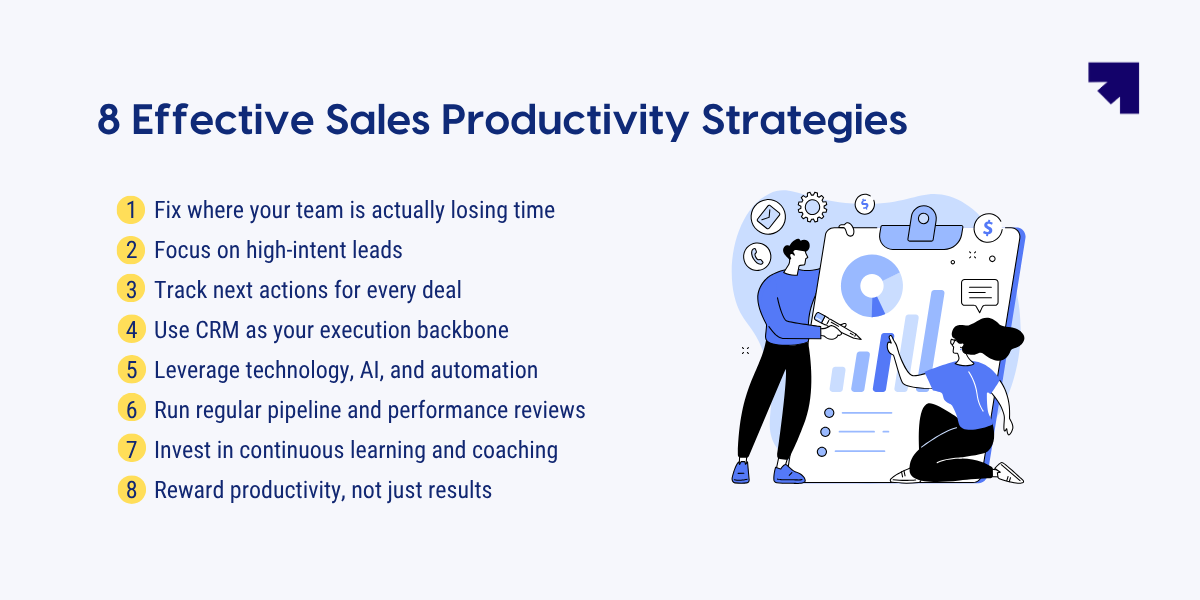
8 Effective sales productivity strategies
Sales productivity does not improve by pushing teams harder. It improves when you remove friction, improve focus, and build systems that support execution.
Here are the eight actionable ways to improve your team’s sales productivity.
1. Define a clear sales process with stage criteria
If stages are unclear, deals move based on assumptions.
Define what each stage means and what must happen before moving forward. This keeps the pipeline clean and prevents false progress.
Clear process → better control → predictable outcomes
2. Focus on high-intent leads
Not all leads deserve equal attention.
Prioritize prospects with real need, urgency, and decision readiness. This ensures your team spends time where it actually matters.
Right focus → better conversions → less wasted effort
3. Track next actions for every deal
Deals slow down when there is no clear next step.
Every opportunity should have a defined next action with a timeline. This keeps momentum consistent and avoids silent drop-offs.
No next step = stalled deal
4. Use CRM as your execution backbone
Scattered tools and personal tracking reduce efficiency.
A customer relationship management CRM centralizes leads, conversations, and deal progress. It gives teams clarity and managers visibility without constant follow-ups.
One system → aligned teams → smoother execution
5. Leverage technology, AI, and automation
Manual work eats into selling time.
Use automation for follow-ups, task creation, lead routing, and activity tracking. AI can help with insights, reminders, and prioritization.
Less manual effort → more selling time → higher output
6. Run regular pipeline and performance reviews
Waiting till month-end is too late.
Review pipeline health, deal movement, and conversion trends regularly. Identify where deals slow down and fix it early.
Real-time visibility → faster decisions → better results
7. Invest in continuous learning and coaching
Sales environments keep changing.
Train teams regularly on product updates, objection handling, and industry trends. Coaching improves how reps handle real conversations.
Better skills → better conversations → better outcomes
8. Reward productivity, not just results
Only rewarding closed deals can create the wrong behavior.
Recognize consistent follow-ups, clean CRM usage, and disciplined execution. This reinforces the habits that actually drive results.
Right incentives → better behavior → sustainable performance
In a nutshell, when these strategies are applied, sales shifts from effort-driven to system-driven. Teams stop chasing work and start managing it with clarity, consistency, and control.
Key sales productivity metrics and how to measure them
Sales productivity improves when you track what actually drives outcomes, not just activity.
Most teams count calls, emails, and meetings. But those numbers alone do not tell you if deals are moving or revenue is improving. The right metrics connect effort to results and show where things break.
1. Revenue per sales rep
This shows how much output each salesperson is generating.
How to measure:
Total revenue ÷ Number of sales reps
It helps you understand individual productivity and spot gaps across the team. If some reps consistently generate more revenue, you can study what they are doing differently.
2. Lead-to-conversion rate
This measures how effectively leads are turning into customers.
How to measure:
(Number of deals closed ÷ Total leads) × 100
A low conversion rate usually points to poor qualification or weak follow-ups. A strong rate indicates better targeting and more effective sales execution.
3. Sales cycle length
This tells you how long it takes to close a deal from the first interaction.
How to measure:
Average number of days from first contact to deal closure
If your cycle is too long, deals may be getting stuck or delayed. Shorter cycles usually mean better clarity, faster decisions, and consistent follow-ups.
Also read: How to reduce sales cycles effectively?
4. Win rate
Win rate shows how many opportunities actually turn into closed deals.
How to measure:
(Number of deals won ÷ Total opportunities) × 100
It reflects how strong your pipeline is and how well your team handles opportunities. A low win rate often means weak qualification or misaligned prospects.
5. Activity-to-outcome ratio
This connects effort with results.
How to measure:
Total activities (calls, emails, meetings) ÷ deals closed
If your team is doing a lot but closing very little, this ratio exposes inefficiency. It helps you understand whether effort is being spent in the right direction.
6. Pipeline velocity
This shows how quickly revenue is moving through your pipeline.
How to measure:
(Number of opportunities × Average deal value × Win rate) ÷ Sales cycle length
It combines deal value, conversion, and speed into one metric. Higher velocity means your pipeline is healthy and moving efficiently.
7. Time spent on selling vs admin work
This reveals how much time is actually spent on revenue-generating work.
How to measure:
Time spent on selling activities ÷ Total working time
If a large portion of time goes into admin tasks, productivity drops. The goal is to maximize selling time by reducing manual work.
8. Follow-up effectiveness
Deals often depend on consistent follow-ups.
How to measure:
Track response rates, number of follow-ups per deal, and deal movement after follow-ups
If follow-ups are delayed or inconsistent, deals slow down or go cold. Strong follow-up discipline improves conversion and deal speed.
These metrics help you move from “how busy the team is” to “how effective the team is.” When tracked consistently, they reveal where deals slow down, where effort is wasted, and where improvements can drive better results. Sales productivity becomes easier to improve when you measure what actually matters.
Top 5 sales productivity tools in 2026
Sales productivity improves when teams stop managing work manually and start using systems that guide execution. The right tools reduce friction, improve visibility, and help teams focus on what actually drives revenue.
1. CRM software (the foundation of sales productivity)
A CRM is not just another tool. It is the system that holds your entire sales process together.
Instead of scattered spreadsheets, emails, and notes, everything sits in one place. Leads, conversations, deal stages, and follow-ups are all tracked inside the CRM. Teams know what is happening, what needs attention, and what comes next without relying on memory.
It also brings automation, task tracking, and real-time pipeline visibility. This means fewer missed follow-ups, better coordination, and more predictable outcomes.
If you get this right, most productivity problems reduce automatically.
Also read: Sales CRM: How Can it Help Your Business?
2. Sales engagement tools
These tools help teams manage outreach at scale.
They allow reps to send emails, make calls, and follow up with prospects in a structured way. Sequences, templates, and reminders ensure communication stays consistent without manual effort.
This improves response rates and saves time spent on repetitive outreach tasks.
3. Email marketing and automation tools
Not every lead is ready to buy immediately.
Email tools help nurture prospects through automated campaigns, targeted messaging, and timely follow-ups. This keeps leads engaged without constant manual intervention.
It ensures no opportunity goes cold due to lack of communication.
4. Sales analytics and reporting tools
Without visibility, productivity cannot improve.
Analytics tools provide insights into pipeline health, conversion rates, deal movement, and team performance. Managers can identify bottlenecks and take action early.
This shifts sales from guesswork to data-driven execution.
5. Collaboration and task management tools
Sales involves coordination across teams.
Collaboration tools help assign tasks, track progress, and ensure everyone involved in a deal is aligned. This reduces delays and improves execution across sales, marketing, and support.
Sales productivity is not about using more tools. It is about using the right tools in the right way. And it almost always starts with a CRM. Once that foundation is strong, everything else becomes easier to manage, track, and improve.
Enhance your sales productivity with Corefactors CRM
Sales productivity does not improve just by adding tools. It improves when your entire sales workflow runs inside one connected system. That is exactly what Corefactors Sales Box is built for.
Corefactors is not just a CRM that stores data. It is designed to control how sales actually gets executed. From the moment a lead enters the system to the final deal closure, every step is structured, tracked, and guided.
#1 Capture, qualify, and route leads automatically
Leads from calls, campaigns, website forms, or referrals flow into one system.
Instead of manual assignment, leads are automatically routed based on rules. High-intent prospects get prioritized, and reps do not waste time figuring out where to start.
Right leads → right reps → faster action
#2 Manage your pipeline with complete visibility
Corefactors gives you a clear, real-time view of your pipeline.
Every deal sits in a defined stage with clear ownership and next actions. Managers do not have to ask for updates. They can see exactly where deals stand, what is stuck, and what needs attention.
This removes guesswork and improves forecasting accuracy.
#3 Built-in calling with conversation intelligence
Sales conversations should not disappear after the call ends.
Corefactors comes with integrated telephony, call tracking, and performance insights. Every interaction is recorded and linked to the deal, giving full context for future follow-ups.
This helps teams improve conversations, not just track them.
#4 Automate follow-ups and daily tasks
Missed follow-ups are one of the biggest productivity killers.
Corefactors automates reminders, tasks, and workflows so reps always know what to do next. Whether it is a call, email, or meeting, the system ensures nothing slips through.
Consistent follow-ups → better deal movement → higher conversions
#5 Engage prospects across multiple channels
Modern sales does not happen on one channel.
Corefactors enables communication across calls, SMS, WhatsApp, and email from one platform. All interactions are tracked in a single timeline, giving a complete view of the customer.
No scattered conversations. No lost context.
#6 Track performance and optimize in real time
You cannot improve what you cannot see.
Corefactors provides dashboards and reports on pipeline health, conversion rates, rep performance, and deal velocity. Managers can identify bottlenecks early and take corrective action.
This turns sales management from reactive to proactive.
With Corefactors, sales productivity is not left to individual effort. It is built into the system.
Your team spends less time managing work and more time closing deals. Your pipeline becomes clearer, follow-ups become consistent, and revenue becomes more predictable.
If your goal is to move from scattered execution to a structured, high-performing sales engine, Corefactors is built to get you there.
Final Thoughts
Improving the sales productivity of the team is not a one‐time process. Instead, it’s a continuous process. Your sales team has to learn every day and every month to perform even better. Follow all the above steps to push your team in the right direction and see productivity growth.
Have you already tried all the above strategies and still no results? Don’t worry; we have a solution. You can make use of the best sales CRM available, Corefactors. It will not only increase the sales productivity but also boost their performance.
Would you like to see the product demonstration?
If yes, then connect with us right away as we are all geared up to take your selling game to a whole new level.
Schedule Demo now!
Enhance Sales Performance
Frequently Asked Questions (FAQs)
What are the most effective tools to boost sales productivity?


CRM software is the most effective tool for boosting sales productivity because it centralizes leads, conversations, and deal stages in one place, eliminating scattered tracking. Beyond CRM, sales engagement tools manage structured outreach, email automation nurtures leads between interactions, and analytics platforms provide pipeline visibility. Collaboration tools keep teams aligned across deals. Together, these reduce manual work and give reps more time for actual selling.
What is an example of sales productivity?
If one sales rep makes fewer calls but closes more deals compared to another who makes more calls with lower conversions, the first rep is more productive. Sales productivity focuses on outcomes like conversions and revenue, not just activity levels.
How can a sales executive improve their productivity using online platforms?
Sales productivity usually drops due to poor lead quality, missed follow-ups, too much manual work, and scattered tools. When teams lack a clear process or visibility into deals, they stay busy but fail to move opportunities forward effectively.
What is a good sales productivity benchmark?
A sales executive can improve productivity by building their workflow around a CRM platform that centralizes leads, follow-ups, and deal stages in one system. From there, using automation for task creation and follow-ups removes manual overhead, while pipeline reviews help identify stuck deals early. Prioritizing high-intent leads and tracking next actions for every opportunity ensures effort goes toward deals that are actually moving forward.
What tools or platforms can help improve sales performance?
CRM platforms improve sales performance by giving teams real-time pipeline visibility, automated follow-ups, and structured deal management. Sales analytics tools identify where deals slow down and measure metrics like conversion rate, win rate, and pipeline velocity. Sales engagement platforms manage outreach at scale, while collaboration tools keep cross-functional teams aligned. The right combination reduces guesswork and helps teams make faster, more informed decisions on every deal.






.png)


.png)