

Why Most ‘Personalized’ Cold Emails Still Feel Generic and 6 Tactics Top Teams Use Instead

Heading 1
Heading 2
Heading 3
Heading 4
Heading 5
Heading 6
Lorem ipsum dolor sit amet, consectetur adipiscing elit, sed do eiusmod tempor incididunt ut labore et dolore magna aliqua. Ut enim ad minim veniam, quis nostrud exercitation ullamco laboris nisi ut aliquip ex ea commodo consequat. Duis aute irure dolor in reprehenderit in voluptate velit esse cillum dolore eu fugiat nulla pariatur.
Block quote
Ordered list
- Item 1
- Item 2
- Item 3
Unordered list
- Item A
- Item B
- Item C
Bold text
Emphasis
Superscript
Subscript

Why Most ‘Personalized’ Cold Emails Still Feel Generic and 6 Tactics Top Teams Use Instead
Join us on November 6th as Mr. Yash Mishra, Product Manager, Fatakpay, reveals the precise strategies that eliminates the speed trap and guarantees a 30% conversion boost.
If you've ever sent a cold email using only a first-name tag and expected a reply, you’ve probably gotten none. Today’s B2B buyers can spot a generic template in seconds. There’s a big difference between a truly personal message and a personalized template. When you rely on the latter, you lose potential deals and create the exact kind of revenue leakage.
The best sales teams don’t try to automate personalization anymore. Instead, they focus on crafting personalized cold emails that genuinely feel like they were written for one specific person. In this blog, you’ll discover why generic emails fail, learn proven tactics, see real examples, and avoid common mistakes.
Why Generic and AI-Written Emails Fail
The problem with cold emails isn’t a lack of data, it’s a lack of context. If your message doesn’t include the right signals at the right time, it won’t get attention, no matter how “personalized” it looks.
1. Over-personalization
Most personalized emails feel generic because the personalization itself is automated. Many teams use templates that automatically add basic details and hope these emails perform well. In practice, this approach rarely works, especially in sales environments.
Automated personalization uses a recipient’s name, company, industry, location, or publicly visible information from LinkedIn or a website. These data points are then stitched together to create some context. The problem is that none of this explains why the message matters to the recipient. As more teams use the same tools and techniques, these “personalized” emails become easier to recognize and easier to ignore.
In reality, personalization depends on many variables – role, timing, company maturity, priorities, and even internal pressures. Automation is great for delivery and sequence, but not for relevance. When context is created without understanding, emails feel templated, no matter how many fields are filled in.
2. Poor Timing
Even a relevant email won’t work if it’s sent at the wrong time. Many emails are sent without considering what’s happening inside the company. They ignore timing completely.
But timing often decides whether someone replies or ignores your message. For example, an email about improving sales processes makes much more sense right after a new Head of Sales is hired - not months before or after. If your email arrives without a clear reason why now, it feels random. And random emails get ignored.
3. Vague Value
Most cold emails are sent to the bin because the value isn’t clear. Generic emails often use broad phrases like “save time,” “increase efficiency,” or “drive growth.” These sound good, but they don’t mean much on their own.
If the reader can’t quickly understand
- What the problem is
- Why it matters
- What changes after they won’t engage.
Strong emails are specific. They focus on one problem and explain it clearly. Without that, even a well-written email feels generic.
Pillars of Effective Cold Email Personalization
Before jumping into tactics, let’s study three main pillars of good personalization:
- Relevance. Your email should connect to a real challenge, goal, or initiative your recipients are facing right now.
- Timing. Send your email when something meaningful happens – a new hire, or a job posting. This shows you’re paying attention to their business events.
- Research. Use the data you’ve gathered to show you understand their situation.
Now, let’s dive into the six tactics top teams use to make their outreach work.
Also read: Is Cold Outreach Still Effective?
The 6 Best Tactics to Overcome Generic Emails
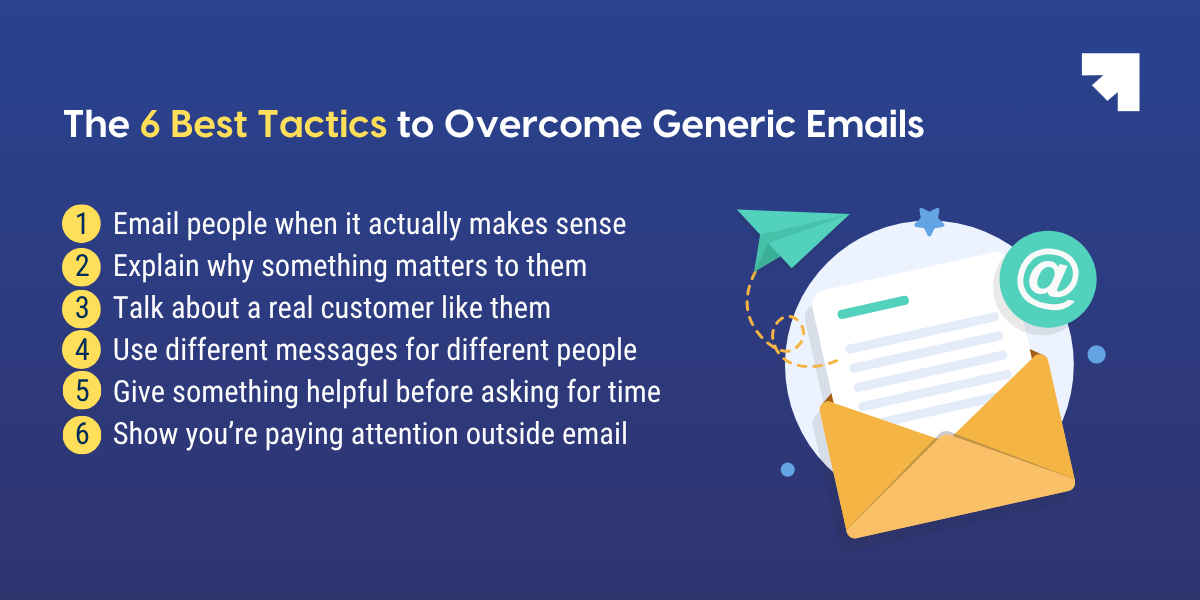
Strong sales teams care more about timing and relevance than names. Here are six tactics they use.
1. Email people when it actually makes sense
Timing is often overlooked, but it’s very important. Top teams use intent data to know not just who to email, but when the person is open to it. This could be after a change in their tech stack, a new executive hire, or a company milestone. For example, if you email about solving team silos right after they hire a Head of RevOps, it shows you understand their needs.
2. Explain why something matters to them
You may list a dozen features for your product, but it’s enough to explain the specific problem it solves. Use data or clear observations to show real impact. For example, “Many finance teams we work with spend hours manually tracking late invoices, which delays cash flow and increases errors.” Automated invoicing reduces time for this task by 30%. Such an email doesn’t sell, it solves a problem.
3. Talk about a real customer like them
Vague claims like “we worked with similar businesses” don’t work. Instead, reference a specific, anonymized example of a customer who faced a very similar challenge. “A B2B SaaS CFO like you was losing 15% of recurring revenue due to manual renewals. We helped fix it in 30 days.” This allows the prospect to self-identify with the problem and visualize the solution.
4. Use different messages for different people
A CFO and a Head of Sales may work at the same company, but they care about different things. Personalized emails should reflect this. Talk about margins and forecasts with finance, but with sales, it’s better to talk about speed and pipeline. Top teams don’t send the same email to different roles; they have a separate message for each person.
5. Give something helpful before asking for time
High-intent personalization means offering value before asking for anything. Forget about gated content. You should send a useful insight and tie it to something the prospect is dealing with right now. If their team is hiring, share a short note on how similar companies set up that role. If you record a Loom video about a small issue on their pricing page and suggest a fix, the conversation shifts from a sales pitch to a practical business solution.
6. Show you’re paying attention outside email
Personalization shouldn't start and end in the inbox. If you connect on LinkedIn, talk about the email you sent. If you are on a call, use the data from your conversation for your future emails. It demonstrates that you view them as a long-term relationship.
Also read: How to Maximize Click Rate for Cold Email Campaigns?
How to Put These Tactics into Practice
Bulk emails don’t get good results. To use these tactics well, you need a smart process. Here’s a simple step-by-step guide to help you get started.
- Figure out who you want to reach. Picture your ideal customer, then sort your email list into groups based on their needs or challenges.
- Pick the right time to reach out. Tools like LinkedIn Sales Navigator can show when companies are ready to buy. Watch for signs like job postings, company news, or staff changes.
- Take a few minutes to research before you write each email. Look up the person and their company, check their recent LinkedIn posts, company updates, and any challenges they mention online.
- Keep your emails brief. Aim for 4 to 7 sentences. Begin with your reason for reaching out, explain how you can help, share a quick example of a similar customer, make it easy for them to reply, and finish with a clear next step.
- Begin with a small batch. Send 20 to 50 personalized emails to one group, see who responds, and focus on what gets the best results.
- Use technology to your advantage. Let software track your results and handle follow-ups. AI tools can suggest ideas, but always review and edit to make sure your emails sound natural.
- Be consistent. Teams that use this process get three to ten times more replies than those who send generic emails. Plus, you’ll have real conversations with people who are interested.
How to Personalize Each Part of a Cold Email
Every part of your email is a separate message.
- Subject line. Make it specific and mention a particular challenge.
- Opening line. Tell why you’re reaching out now, for example, a funding opportunity, a post they shared, or a product update. One or two sentences are enough.
- Value statement. Talk about outcomes and not about features. Show how you solve a real problem they’re also facing.
- Social proof. Share a quick example of a similar case, without naming names.
- Call to action. Keep it easy to respond to. Ask a simple question or suggest a short 10-minute call instead of a long meeting.
- Sign-off. Be human and warm and match the tone of your email.
Examples of Good vs Bad Personalized Cold Emails
❌ Bad (generic)
Subject: Hi Michael, partnership opportunity
Body: Hi Michael, I’ve noticed you are in the SaaS industry. We can help your company increase sales. Let’s chat?
This feels robotic and will be deleted.
✅ Good (contextual)
Subject: Quick idea after your recent pricing page update
Body: Hi Michael, I noticed the updated pricing on your site. We partnered with a B2B SaaS team and helped them cut their quote-to-close time by 40% with automated pricing tools. Here’s a minute Loom to explain it. Would you be open to taking a quick look?
This shows you know exactly how you can help them.
Common Mistakes in Cold Email Personalization
Mistakes happen, unfortunately. But you make fewer of them when you know what to watch for:
- Shallow personalization. A company name and title are not enough. You should show that you really know your recipient. Plus, a strong start is wasted if the rest of the email is generic. Your value statement should match the challenge you mentioned at the beginning.
- Getting too personal. At the same time, never be intrusive. You should stick to a professional context and refer to company milestones. Never reference something from a person's personal social media or private life.
- Over-researching. You don’t have to retell the company's history and achievements. One strong, relevant insight usually does the trick.
- Forgetting the follow-up. The first email is just the opening scene. Your follow-ups should also be personalized. Reference your previous email or share a new piece of relevant content. The conversation continues outside the first inbox.
Also read: 7 Email Marketing Mistakes to Avoid
Conclusion
Most cold emails still remain generic because teams prioritize data points and ignore real understanding. Buyers immediately spot generic wording and hit delete. You lose opportunities with each of these clicks.
Top teams act differently. They automate with care and build genuine context. They email at the perfect moment, speak directly to specific roles, share real cases and offer value upfront.
These are habits you can build following this guide. Follow the pillars of relevance, timing, and thoughtful research. Experiment with the six tactics described above. Learn to personalize every part of the email and avoid shallow or creepy overreach. Test small batches, track results, and refine.
You will see the payoff very soon – you will start getting better replies. Make personalization your core skill and keep developing it. Your outreach will feel human again, and it's what wins in B2B sales.
Heading 1
Heading 2
Heading 3
Heading 4
Heading 5
Heading 6
Lorem ipsum dolor sit amet, consectetur adipiscing elit, sed do eiusmod tempor incididunt ut labore et dolore magna aliqua. Ut enim ad minim veniam, quis nostrud exercitation ullamco laboris nisi ut aliquip ex ea commodo consequat. Duis aute irure dolor in reprehenderit in voluptate velit esse cillum dolore eu fugiat nulla pariatur.
Block quote
Ordered list
- Item 1
- Item 2
- Item 3
Unordered list
- Item A
- Item B
- Item C
Bold text
Emphasis
Superscript
Subscript
Frequently Asked Questions (FAQs)
What’s the ideal length for a personalized cold email?


An optimal email is no longer than 7 sentences (under 150 words). Remember to include the subject line, opening, value statement, proof, and call to action. A good reply rate typically ranges from 10% to 25%, depending on the industry.
How can I attract attention via the subject line?
You may mention something specific - it can be a recent company update, role change, or common challenge, but keep it short and curiosity-driven.
Can I use AI to write personalized cold emails?
AI is absolutely great for research, subject lines, or draft ideas. However, it will not replace human creativity and judgment. Always review and add your own voice.
What is the most common mistake people make when personalizing cold emails?
It is pretending to personalize by only changing the name or company. Instead, focus on one meaningful insight that is relevant right now.
How much personalization is enough for cold emails?
Enough to make the person feel the email was written just for them. Focus on 1–3 relevant details, for example, their role, recent changes, or challenges. Too little feels generic; too much can feel forced.





.png)


.png)