

What Is Presales? Definition, Difference & Strategic Steps Behind High-Performing Sales Teams

Heading 1
Heading 2
Heading 3
Heading 4
Heading 5
Heading 6
Lorem ipsum dolor sit amet, consectetur adipiscing elit, sed do eiusmod tempor incididunt ut labore et dolore magna aliqua. Ut enim ad minim veniam, quis nostrud exercitation ullamco laboris nisi ut aliquip ex ea commodo consequat. Duis aute irure dolor in reprehenderit in voluptate velit esse cillum dolore eu fugiat nulla pariatur.
Block quote
Ordered list
- Item 1
- Item 2
- Item 3
Unordered list
- Item A
- Item B
- Item C
Bold text
Emphasis
Superscript
Subscript

What Is Presales? Definition, Difference & Strategic Steps Behind High-Performing Sales Teams
.png)
Hifzur Rahman
Join us on November 6th as Mr. Yash Mishra, Product Manager, Fatakpay, reveals the precise strategies that eliminates the speed trap and guarantees a 30% conversion boost.
Presales often sits quietly in the pipeline, but why do some deals feel “almost closed” yet never move forward? The gap is usually not in selling, but in how well the problem, solution, and expectations are aligned before the final decision. According to McKinsey & Company, strong presales capabilities drive 40–50% win rates and 80–90% renewal rates.
Presales is where that clarity is built. It helps teams understand customer needs, validate the right fit, and remove uncertainty early so deals do not stall later. In this blog, we will understand what presales is, why it is important, presales best practices, and more.
What is presales?
Presales is the stage before a deal is closed where teams focus on understanding customer needs, demonstrating the product, and validating whether the solution is the right fit. It includes activities like discovery calls, product demos, requirement analysis, solution mapping, and answering technical or business questions.
The purpose of presales is to build confidence and reduce uncertainty before a buying decision is made. For example, in a SaaS company, a prospect shows interest in a CRM. The presales team conducts a discovery call, understands their sales process, gives a tailored demo, and shows how the CRM fits their workflow. By the time the deal moves to sales closure, the customer already knows what to expect, making the decision smoother and faster.
Why presales is important
Many deals do not fall through at the closing stage. They fall through much earlier, when the customer is still unsure if your solution actually fits their needs. That is exactly where presales plays a critical role.
1. Reduces uncertainty before the buying decision
Customers rarely buy just based on features or pricing. They want to understand how the solution will work for their specific use case.
Presales helps remove this uncertainty by answering questions, demonstrating real use cases, and showing how the product fits into the customer’s workflow. When clarity increases, hesitation reduces, and decisions become easier.
2. Improves conversion quality, not just volume
Without presales, sales teams may push deals forward that are not the right fit.
Presales ensures that only qualified and well-understood opportunities move ahead. This improves conversion rates and reduces the number of deals that drop off later in the pipeline.
Better qualification → stronger deals → higher win rates
3. Shortens the sales cycle
When customers clearly understand the product before the final stage, fewer objections come up during closing.
Presales addresses key concerns early, whether it is functionality, integration, or implementation. This reduces back-and-forth later and helps deals move faster.
Early clarity → fewer objections → quicker decisions
Also read: How To Accelerate Sales Cycle And Why Is It Important For Businesses
4. Builds trust and credibility
Customers are more likely to move forward when they feel understood.
Presales teams focus on listening, asking the right questions, and tailoring solutions instead of pushing a generic pitch. This builds trust and positions the business as a partner rather than just a vendor.
5. Aligns expectations before onboarding
One of the biggest reasons for post-sale issues is misaligned expectations.
Presales ensures that what is promised during the sales process matches what the product actually delivers. This leads to smoother onboarding and better customer satisfaction.
6. Supports sales teams with deeper expertise
Sales representatives may not always have deep technical or product knowledge.
Presales teams bridge this gap by providing detailed insights, handling complex queries, and supporting solution discussions. This strengthens the overall sales conversation.
Presales is not just a support function. It is a critical stage that shapes how customers understand your solution and how confidently they make a decision. When done right, it improves deal quality, builds trust, and makes the entire sales process more efficient and predictable.
Presales process: 9 Winning steps
Why do some prospects move smoothly from interest to decision, while others drop off even after multiple calls? The difference usually lies in how well the presales process is structured.
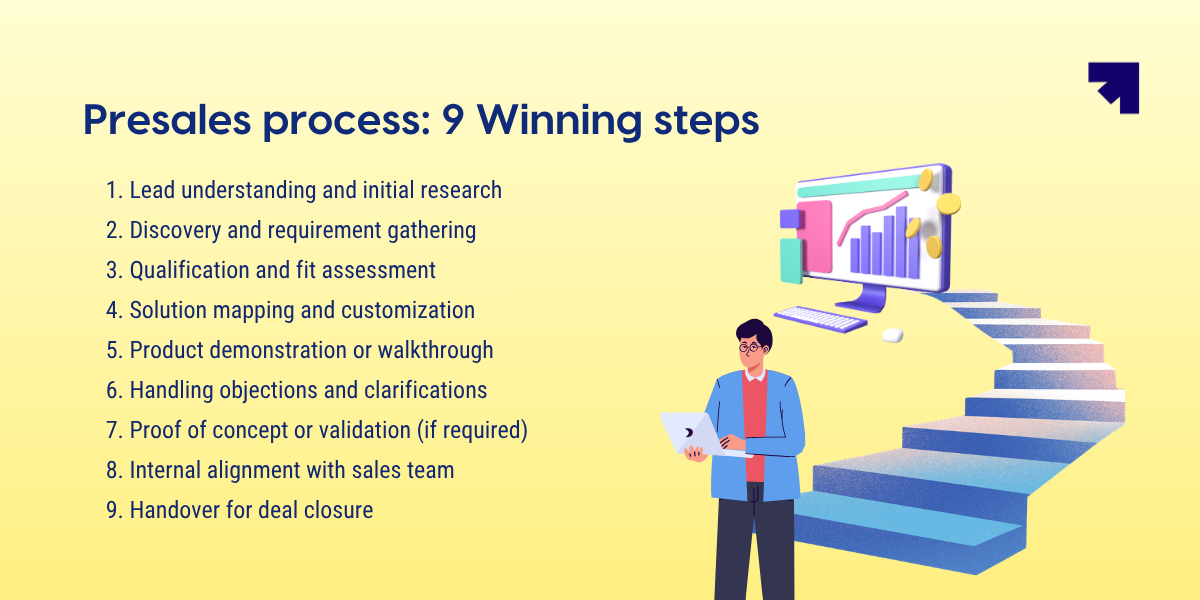
1. Lead understanding and initial research
Presales starts with understanding who the prospect is before engaging deeply.
This includes reviewing company details, industry context, use case signals, and how the lead came in. This preparation helps the team ask relevant questions instead of starting with a generic pitch.
Better context → sharper conversations → higher engagement
2. Discovery and requirement gathering
This is one of the most critical steps in presales.
The goal is to understand the customer’s current process, challenges, expectations, and success criteria. Instead of focusing on the product, the focus is on the problem.
Good discovery → clear problem definition → stronger solution fit
3. Qualification and fit assessment
Not every prospect is the right fit.
At this stage, the team evaluates whether the prospect aligns with the product’s capabilities, budget, and timeline. This prevents weak or misaligned deals from moving forward.
Right fit → better conversion → lower churn later
Also read: BANT Framework for Lead Qualification
4. Solution mapping and customization
Once requirements are clear, the next step is to map the solution to the customer’s needs.
This involves aligning product features with specific use cases and showing how the solution solves their problems. The focus is on relevance, not feature dumping.
Problem → solution mapping → perceived value increases
5. Product demonstration or walkthrough
The demo is where everything comes together.
Instead of a generic walkthrough, the demo is tailored based on discovery insights. It focuses on the customer’s use case, showing exactly how the product fits into their workflow.
Relevant demo → better understanding → higher confidence
6. Handling objections and clarifications
Prospects often have questions around pricing, implementation, integrations, or outcomes.
Presales teams address these concerns early and clearly. This reduces friction in later stages and avoids surprises during closing.
Early clarity → fewer objections → smoother progression
7. Proof of concept or validation (if required)
For complex or high-value deals, prospects may want validation before committing.
This can include a proof of concept, trial, or pilot. It allows the customer to see the solution in action within their environment.
Validation → reduced risk → stronger buying intent
8. Internal alignment with sales team
Presales does not work in isolation.
The team collaborates with sales to share insights, qualification details, and customer expectations. This ensures the closing conversation is aligned with what was already discussed.
Aligned teams → consistent messaging → better closure
9. Handover for deal closure
Once the prospect is confident and aligned, the opportunity moves to the closing stage.
Presales ensures that all requirements, expectations, and context are clearly documented and shared. This helps sales close the deal without rework or confusion.
Clear handover → faster closure → better experience
What this process ensures: A structured presales process ensures that prospects are not just interested, but informed and confident.
Discovery → Qualification → Solution mapping → Demo → Validation → Alignment
When these steps are executed well, presales reduces friction, improves deal quality, and makes the entire sales journey more predictable.
Presales vs. sales: What’s the difference?
Presales focuses on understanding needs and validating the right solution, while sales focuses on closing the deal and converting the opportunity into revenue.
Presales happens before the final decision is made. It is centered around discovery, requirement gathering, product demonstrations, and solution alignment. The goal is to help the customer clearly understand how the product fits their use case and to remove uncertainty early in the buying journey. This stage is more consultative, where the focus is on problem-solving rather than pushing for a sale.
Sales takes over once the prospect is confident and ready to move forward. The focus shifts to negotiations, pricing discussions, final approvals, and closing the deal. While presales builds trust and clarity, sales ensures the deal is finalized and converted into revenue. Both functions work closely together, but they operate at different stages of the customer journey with distinct responsibilities.
Presales best practices
Presales is not about doing more demos or answering more questions. It is about giving the right clarity at the right time so the customer can make a confident decision.
Here are the practices that actually improve how presales works in real scenarios.
1. Start with the problem, not the product
Many presales conversations fail because teams jump into product features too early.
Take time to understand how the customer currently works, what challenges they face, and what they are trying to improve. Ask questions that uncover gaps in their process instead of assuming the problem.
When the problem is clearly defined, your solution becomes easier to position and more relevant.
2. Qualify early and honestly
Not every lead that shows interest is worth pursuing.
Evaluate whether the prospect has a real need, decision authority, budget, and a timeline. If any of these are missing, it is better to identify it early instead of pushing the deal forward.
This helps your team focus on stronger opportunities and prevents pipeline clutter.
3. Customize every interaction
Generic conversations reduce engagement quickly.
Use the information gathered during discovery to tailor your approach. This includes how you speak, what you show, and what you prioritize during discussions.
When the customer feels the conversation is specific to their situation, they pay more attention and engage more actively.
4. Keep demos focused on outcomes
A demo should not feel like a full product walkthrough.
Focus only on the parts of the product that solve the customer’s problem. Show how their current process can improve and what outcomes they can expect.
Too many features create confusion, while focused demos create clarity.
5. Address objections early
Most objections are predictable.
Customers usually have concerns around pricing, implementation, integrations, or effort required. Bring these topics into the conversation early instead of waiting for the closing stage.
When objections are handled during presales, the final decision becomes much smoother.
6. Work closely with the sales team
Presales and sales need to operate as one unit.
Share insights about customer expectations, requirements, and concerns clearly. This ensures that the final sales conversation continues from where presales left off instead of starting again.
This alignment improves consistency and builds customer confidence.
7. Document key insights clearly
Important details should not stay in conversations or memory.
Capture customer requirements, use cases, objections, and expectations in a structured format. This helps both in closing the deal and in onboarding later.
Good documentation ensures continuity across teams and stages.
8. Know when to step back
Not every opportunity should be forced to closure.
If the fit is not right or the customer is not ready, pushing the deal can create problems later. It may lead to churn or dissatisfaction.
Taking a step back when needed helps maintain long-term credibility and trust.
Strong presales is not about doing more work. It is about doing the right work with clarity and intent. When discovery is sharp, conversations are relevant, and expectations are aligned, presales naturally leads to better conversions and smoother customer journeys.
Key roles and responsibilities in presales
Presales sits between interest and decision. Its role is to understand the customer, validate the fit, and build confidence before the deal moves to closure.
Here are the core responsibilities that define effective presales execution:
1. Understanding customer requirements
Presales teams lead discovery conversations to understand the customer’s current process, challenges, and goals. This forms the foundation for everything that follows.
2. Qualifying opportunities
They assess whether the prospect is a good fit based on need, use case, budget, and timeline. This helps avoid weak or misaligned deals entering the pipeline.
3. Solution mapping
Presales translates customer requirements into a clear solution. Instead of listing features, they show how the product solves specific problems.
4. Conducting tailored demos
They deliver product demonstrations based on the customer’s use case. The focus is on relevance and outcomes, not a generic walkthrough.
5. Handling technical and product queries
Presales teams address deeper questions around functionality, integrations, implementation, and limitations. This builds clarity and trust.
6. Supporting the sales team
They work closely with sales to strengthen conversations, provide insights, and ensure alignment before closing discussions.
7. Managing proofs of concept (POCs)
For complex deals, presales may run trials or POCs to validate the solution in the customer’s environment.
8. Documenting insights and handover
They capture key requirements, expectations, and discussions, and pass this context clearly to sales or customer success teams.
Strong presales professionals combine multiple skills to execute this effectively. They need clear communication to guide conversations, analytical thinking to understand customer problems, product knowledge to map the right solution, and business understanding to connect features with outcomes. Most importantly, they must be good listeners, because the quality of presales depends on how well they understand before they present.
Common presales job titles
- Presales Executive
- Sales Engineer
- Solutions Consultant
- Presales Consultant
- Technical Consultant
- Solutions Architect
Presales tools and technologies
Presales is not just about conversations. It depends on how well you capture context, demonstrate value, and move opportunities forward with clarity.
Here are the key tools that support effective presales execution:
| Purpose | Tools |
|---|---|
| CRM & pipeline management | Corefactors, Salesforce, HubSpot CRM, Zoho CRM |
| Proposal & RFP management | PandaDoc, Loopio, Qvidian |
| Demo & presentation | Zoom, Microsoft Teams, Loom |
| Analytics & reporting | Tableau, Power BI |
| Collaboration | Slack, Trello, ClickUp |
Pro tip: The real value is not in using more tools, but in using the right ones together. When your CRM, communication, and analytics tools are connected, presales becomes faster, more relevant, and easier to scale.
Conclusion
Sales and presales do not fail because of lack of effort. They fail when there is no structure behind how teams qualify, engage, and move opportunities forward.
What this blog comes down to is simple. Sales management brings control to execution, while presales brings clarity to decision-making. When both work together, deals move with purpose instead of uncertainty.
The real shift happens when businesses move from scattered tools and reactive follow-ups to structured processes supported by the right systems. With clear pipelines, defined responsibilities, and connected tools like CRM, teams stop chasing deals and start managing them.
In the end, predictable growth is not about doing more. It is about managing every stage of the customer journey with clarity, consistency, and control. Investing in CRM, preferably modern age CRMs, powered by AI like Corefactors AI CRM, that auto enable RevOps in the business processes and helps businesses grow faster has become a need of the hour for all businesses irrespective of their size and the industry they operate in.
Heading 1
Heading 2
Heading 3
Heading 4
Heading 5
Heading 6
Lorem ipsum dolor sit amet, consectetur adipiscing elit, sed do eiusmod tempor incididunt ut labore et dolore magna aliqua. Ut enim ad minim veniam, quis nostrud exercitation ullamco laboris nisi ut aliquip ex ea commodo consequat. Duis aute irure dolor in reprehenderit in voluptate velit esse cillum dolore eu fugiat nulla pariatur.
Block quote
Ordered list
- Item 1
- Item 2
- Item 3
Unordered list
- Item A
- Item B
- Item C
Bold text
Emphasis
Superscript
Subscript
Frequently Asked Questions (FAQs)
What are the key activities in presales?


Presales includes activities like discovery calls, requirement gathering, product demos, solution mapping, and handling technical queries. The goal is to understand customer needs and validate the right solution before moving to closure.
How is presales different from sales?
Presales focuses on understanding the customer’s problem and demonstrating the right solution, while sales focuses on negotiation and closing the deal. Presales builds confidence, and sales converts that confidence into revenue.
What skills are required for presales?
Presales professionals need strong communication, problem-solving, and analytical skills. They also require good product knowledge, the ability to understand business needs, and the skill to translate features into real customer outcomes.
What is the presales process?
The presales process typically includes lead research, discovery, qualification, solution mapping, demos, handling objections, and aligning with sales for closure. Each step ensures the customer is informed and confident before making a decision.
Why do companies need a presales team?
Companies need presales teams to improve deal quality and reduce uncertainty in the buying process. Presales helps qualify leads better, address concerns early, and build trust, leading to higher conversions and smoother closures.




.png)



.png)


.png)