

.png)
2X Productivity & Stronger Conversions: How Sanchu Animal Hospital Achieved It
Karthik.A
A behind-the-scenes story of scattered data, hidden performance, and how the right system turned everyday activity into measurable outcomes.
Sanchu Animal Hospital had grown into a one-stop destination for pet care, from clinical treatment and grooming to retail and home visits. Inquiries came in regularly through social media and referrals, so demand was never an issue. Managing that demand was the real challenge.
The backend team spent most of their day juggling spreadsheets, files, and appointment logs instead of helping customers quickly. Leadership had no clear view of who was productive, how fast responses were going out, or how many inquiries were actually turning into visits.
Everything changed when Corefactors stepped in and set things straight. Suddenly, there was visibility, accountability, and a clear way to manage the growing workload without burning out the team. And honestly, the results even surprised them. Want to know what happened next? Read the full story.
Client’s Love 💙
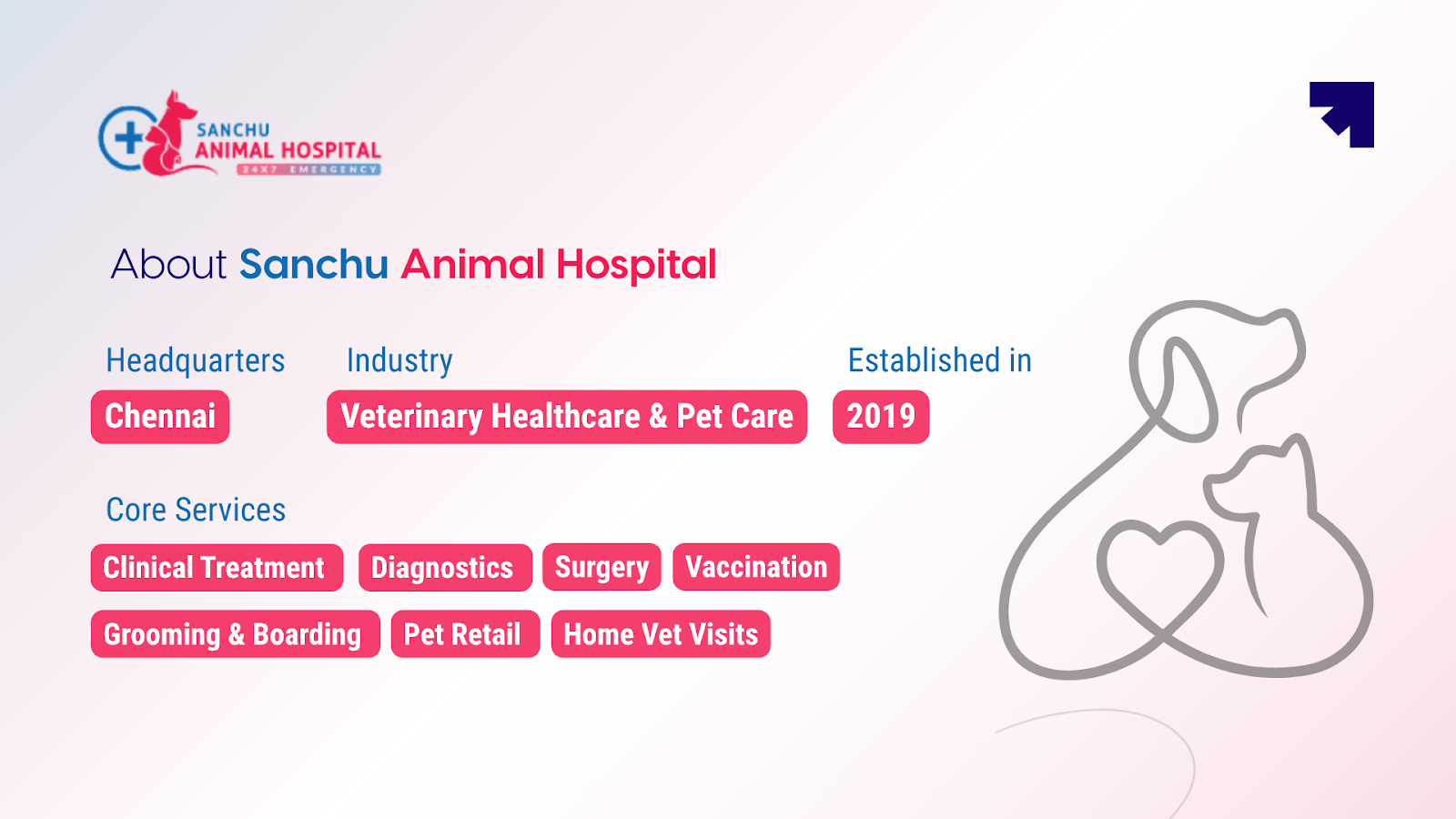
About Sanchu Animal Hospital
Sanchu Animal Hospital is a full-service veterinary facility delivering end-to-end care for pets and convenience for pet parents.
Its service portfolio includes:
- Clinical veterinary treatment
- Advanced hospital facilities
- Home visit services
- Pet grooming and salon services
- Retail store for pet products
A backend operations team of approximately ten members manages inquiries, appointments, and customer communications across these services.
As customer interactions increased, the manual systems used to coordinate them became a major operational bottleneck.
Challenges Sanchu Animal Hospital Faced
1. Fragmented data storage across Excel and OneDrive
Customer records, appointments, and inquiry details were maintained manually in spreadsheets and cloud folders. This created several problems:
- Frequent manual updates and corrections
- Risk of data inconsistencies
- Difficulty locating information quickly
- No centralized view of the customer journey
Instead of supporting operations, the system consumed staff time.
2. Absence of a lead management framework
Before Corefactors, the hospital relied on a basic telephony tool with IVR functionality but lacked structured lead tracking.
As Shenbagaraj R mentioned, “We used basic software. It only had a tele system. We didn’t have proper lead management.”
As a result:
- Inquiries were not systematically captured or categorized
- Follow-ups depended on individual memory or manual notes
- No standardized process existed for moving leads toward appointments
This made performance unpredictable and difficult to improve.
3. Limited visibility into agent activity and productivity
Leadership could not answer fundamental operational questions such as:
- How many calls each agent made daily
- How many appointments were scheduled
- Which agents were most effective
- Whether workload distribution was balanced
“Our main goal was to measure data and improve agent productivity.”
- Shenbagaraj R, Head of Sales, Marketing & Operations
Without measurable data, managing the team relied largely on assumptions rather than evidence.
4. Heavy manual workload reduced effective output
Backend agents spent a significant portion of their day handling administrative tasks:
- Recording data
- Searching for customer details
- Updating files
- Coordinating appointments
This reduced the time available for direct customer engagement - the activity most likely to generate revenue.
5. Delayed response to new inquiries
Social media campaigns generated leads, but there was no automated capture mechanism. Each inquiry had to be manually logged before action could be taken.
This introduced delays that could reduce the likelihood of conversion, particularly when customers were evaluating multiple service providers.
6. Lack of performance analytics and reporting
With no dashboards or structured reports:
- Tracking trends over time was difficult
- Identifying bottlenecks was nearly impossible
- Team meetings relied on anecdotal information rather than data
- Continuous improvement efforts lacked direction
How Corefactors Reshaped Their Operations
Sanchu adopted Corefactors after receiving a referral from a neighboring business already using the platform. Following a demonstration, it was selected as the central system to organize and automate customer interactions.
“Our neighboring business, Green Trends, was using it. They referred it to us. We had a demo session and were satisfied.” - Shenbagaraj R, Head of Sales, Marketing & Operations
1. Automated capture of social media leads
Corefactors integrates directly with social media channels, allowing campaign responses to enter the system automatically.
Impact:
- Eliminated manual data entry
- Reduced risk of missed inquiries
- Enabled immediate visibility of new leads
- Standardized intake of customer information
2. Centralized repository for all customer data
Instead of scattered files, all information now resides in one platform.
Benefits include:
- Faster access to customer history
- Reduced duplication of effort
- Improved accuracy of records
- Consistent information across the team
3. Leadbox for structured tracking and follow-up
Leadbox provides a clear view of both customer details and agent interactions.
“Leadbox is the best feature. It gives clear visibility of customer and agent data.” - Shenbagaraj R, Head of Sales, Marketing & Operations
Teams can now:
- Monitor the status of each inquiry
- Track communication history
- Prioritize follow-ups effectively
- Maintain continuity in customer conversations
The hospital identified Leadbox as the most valuable feature.
4. Significant reduction in manual administrative effort
Automation handles routine data management tasks, freeing agents to focus on outreach and appointment booking.
This shift directly increased productive time spent on revenue-generating activities.
5. Rapid response capability for new inquiries
With real-time lead visibility, agents can contact prospects within approximately five minutes of capture.
Engaging customers while their interest is high improves the chances of securing appointments.
“Agents can call leads within five minutes of capture.” - Shenbagaraj R, Head of Sales, Marketing & Operations
6. Holistic performance analytics for management
Dashboards now provide actionable insights, including:
- Number of calls made per agent
- Appointment booking activity
- Overall team productivity
- Comparative performance across staff
This visibility enables more effective coaching, planning, and accountability.
“Now I can track how many calls each agent makes and how many appointments they book. It helps me conduct better team meetings.” - Shenbagaraj R, Head of Sales, Marketing & Operations
7. Alignment with existing marketing efforts
The hospital continues to run campaigns on social platforms, but all resulting leads are now consolidated in the CRM, ensuring consistent handling regardless of source.
Results?
For Sanchu Animal Hospital, implementing Corefactors was not simply a technology upgrade. It fundamentally changed how the organization manages customer interactions.
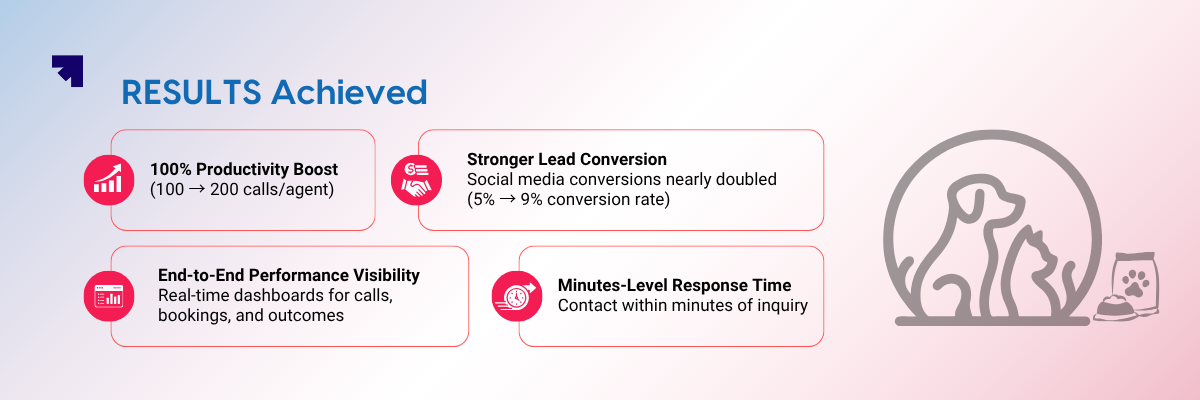
1. Impressive increase in agent productivity
Automation reduced time spent on manual tasks, enabling agents to handle more customer interactions.
- Previous daily output: Around 100 calls per agent
- Current daily output: Around 200 calls per agent
- Reported improvement: Approximately 100%
2. Improved conversion of social media leads
Faster follow-ups and structured tracking contributed to higher conversion rates.
- Earlier conversion rate: About 5%
- Current conversion rate: About 9%
3. Real-time engagement with new prospects
Agents can now respond within minutes of lead capture, significantly reducing the risk of losing interested customers.
4. Full operational visibility for leadership
Managers now have clear, real-time insight into team performance and outcomes, enabling data-driven decision-making.
5. Transition from manual operations to automation
The organization has moved completely away from spreadsheet-based tracking to a centralized CRM workflow.





.png)


.png)