

How to Get a Toll-Free Number in India: A 2026 Guide

Heading 1
Heading 2
Heading 3
Heading 4
Heading 5
Heading 6
Lorem ipsum dolor sit amet, consectetur adipiscing elit, sed do eiusmod tempor incididunt ut labore et dolore magna aliqua. Ut enim ad minim veniam, quis nostrud exercitation ullamco laboris nisi ut aliquip ex ea commodo consequat. Duis aute irure dolor in reprehenderit in voluptate velit esse cillum dolore eu fugiat nulla pariatur.
Block quote
Ordered list
- Item 1
- Item 2
- Item 3
Unordered list
- Item A
- Item B
- Item C
Bold text
Emphasis
Superscript
Subscript

How to Get a Toll-Free Number in India: A 2026 Guide
.png)
Vimal M
Join us on November 6th as Mr. Yash Mishra, Product Manager, Fatakpay, reveals the precise strategies that eliminates the speed trap and guarantees a 30% conversion boost.
A toll-free number in India (starting with 1800) is a business phone number that customers can call without paying any charges. It helps remove friction in communication and makes it easier for people to reach your business when it matters most.
A toll-free number often works as a central system behind the scenes, organizing how calls are received and handled. It helps ensure every enquiry reaches the right team without confusion or delays.
If you're wondering how to get a toll-free number in India, its key benefits, features, and why intermediaries like Corefactors make the process easier, this blog covers everything you need to make the right decision.
What is a toll-free number?
A toll-free number is a phone number that lets customers call a business without paying for the call. Instead, the business covers the cost. In India, it typically starts with the toll-free prefix “1800” followed by the remaining digits. For the caller, it feels simple and risk-free. For the business, it removes a small but real barrier to starting a conversation.
In practice, a toll-free number makes it easier for customers to reach you. It routes incoming calls to your sales, support, or service teams, often through a cloud-based system. Many setups include call routing, IVR menus, call recording, and analytics. This means every call can be tracked, managed, and improved over time, rather than being just a missed or unmanaged interaction.
You will see toll-free numbers widely used across sectors where customer interaction matters. This includes e-commerce, banking, insurance, healthcare, travel, telecom, and SaaS companies. Any business that handles inbound queries, support requests, or sales calls benefits from it. It signals accessibility, builds trust, and gives customers a clear way to connect when they need help.
What is meant by the 1800 number?

An 1800 number is the Indian format of a toll-free number that allows customers to call a business at no cost to them. The charges are paid by the business receiving the call. This makes it easier for customers to reach out without worrying about call expenses, especially for support or enquiries.
For businesses, an 1800 number acts as a dedicated and professional contact line. It can be routed to different teams, locations, or devices based on availability. This ensures calls are handled quickly and do not get lost, even as the business scales.
It is commonly used by customer-facing teams across industries like banking, e-commerce, healthcare, and telecom. More than just a number, it signals trust and accessibility, showing customers that the business is ready to listen and support when needed.
.png)
7 Benefits of using a 1800 toll-free number
If you want more people to call you and fewer to drop off, this change quietly does a lot of heavy lifting. Here are the "benefits of using 1800 toll-free numbers":
1. Free for callers removes hesitation
Calling you costs nothing for the customer. That matters more than it seems. When there is zero cost, people are quicker to call, ask, and decide, especially during high-intent moments.
2. One number that works across India
You do not need different numbers for different cities. A single 1800 number works nationwide. It keeps your brand consistent and easy to remember, whether the customer is in Chennai or Chandigarh.
3. Stronger brand recall with a simple number
1800 numbers are easier to recognize and trust. Over time, customers remember the number without needing to look it up again. This improves repeat engagement and reduces dependency on constant reminders.
4. Trackable campaigns, not just missed calls
You can assign different toll-free numbers to different campaigns. This helps you see what is actually driving calls. Instead of guessing, you know which ad, channel, or region is working.

5. Better control over incoming demand
Not all calls are equal, and not all teams should handle everything. You can route calls by language, location, or intent. This keeps conversations relevant and reduces unnecessary transfers.
6. Capture intent when it is highest
A call usually means the customer is ready to act or needs clarity fast. A toll-free number helps you catch that moment. You connect when interest is fresh, not after it fades.
7. Clean data for smarter decisions
Every call leaves behind useful data. You can track volume, peak hours, missed calls, and outcomes. Over time, this gives you clear signals on where you are winning and where you are losing.
How does a toll free number work in India?
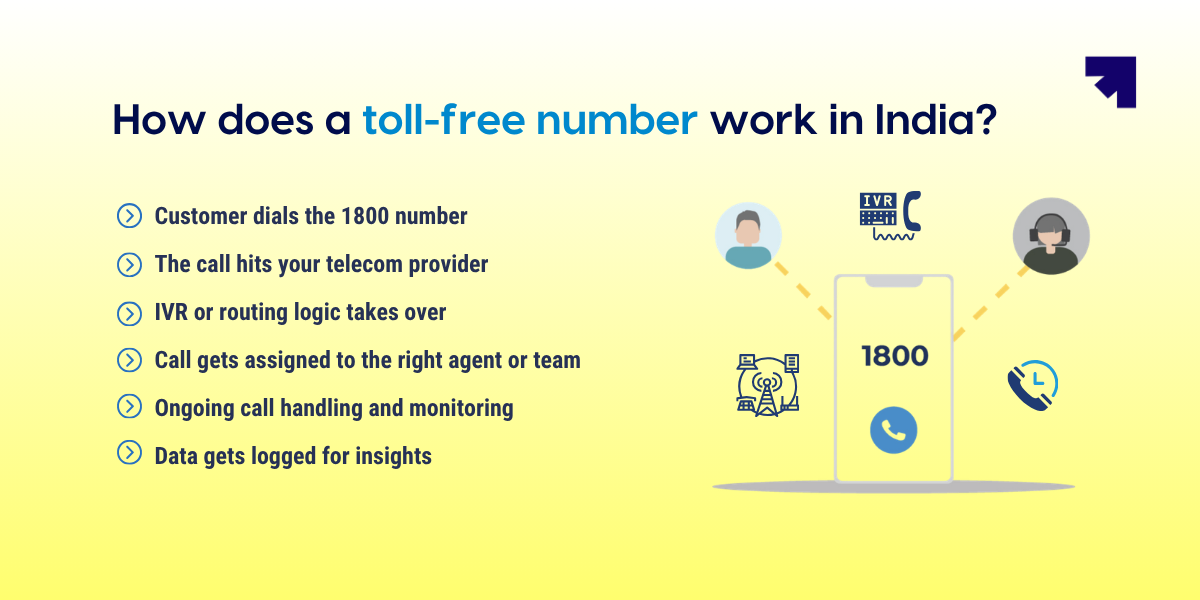
A toll free number operates through a structured call-routing system. Here’s how it works:
1. Customer dials the 1800 number
The process starts when a customer calls your toll-free number. The call is free for them, so there is no hesitation. This is often the first step where intent shows up clearly.
2. The call hits your telecom provider
The call is received by your toll-free service provider. They act as the bridge between the caller and your business system. From here, routing decisions begin based on your setup.
3. IVR or routing logic takes over
The system checks predefined rules to decide where the call should go. It could be an IVR menu, a specific team, or a region-based route. This ensures the caller is directed without manual intervention.
4. Call gets assigned to the right agent or team
Based on the selection or logic, the call is routed to the most relevant person. It could be sales, support, or a specific branch. This reduces wait time and improves the quality of the conversation.
5. Ongoing call handling and monitoring
While the call is active, features like recording, tracking, and call queues may run in the background. This helps maintain quality and ensures no calls are lost during peak times.
6. Data gets logged for insights
Once the call ends, details like duration, source, and outcome are captured. This data helps you understand performance and identify gaps. Over time, it turns your call flow into a measurable system.
Top 5 features of a 1800 toll-free number
Once you set it up, it is not just a number. It becomes a system that quietly manages how your calls are handled every day. It helps you stay responsive, organized, and in control, even when call volumes grow.
Here are some of the key features of buying a toll free number:
1. Intelligent call routing
Calls are not sent randomly. You can route them based on team, location, language, or time of day. This ensures the right person picks up, which improves both speed and conversation quality.
2. IVR (interactive voice response)
IVR greets callers and guides them to the right option. It reduces confusion and cuts down manual transfers. Even a simple menu can make your call handling feel structured and professional.
3. Call recording and monitoring
Every call can be recorded for review and training. This helps you understand what is working and what is not. Over time, it improves team performance and keeps conversations consistent.
4. Real-time analytics and reporting
You get visibility into call volumes, missed calls, response times, and more. These are not just numbers, they show where you are losing or winning opportunities. It helps you make better decisions without guesswork.
5. Call queuing and handling during peak hours
When multiple calls come in, the system manages them in a queue. Customers are not dropped or ignored. This keeps your experience smooth even during busy periods, when demand is at its highest.
What are the use cases of a toll-free number?
These use cases will help you better understand the role toll-free numbers play in elevating businesses.
1. Customer support helpline
Enables customers to receive the required assistance immediately, at any time, from anywhere. They just need to dial the organization’s toll-free number.
2. E-Commerce order inquiries
Instills confidence among your customers by enabling them to check on their order’s whereabouts, delivery timelines, and any other concerns they may have by dialing your business number.
3. Banking and financial services
Giving your prospects or customers a way to contact your business for free encourages more people to call. Whether it is reporting a lost card, resolving transaction disputes, or seeking financial advice, these helplines offer round-the-clock support, ensuring customers' peace of mind no matter where they are.
4. Healthcare consultations
Allows patients to seek medical advice, schedule appointments, or book an ambulance during an emergency at any time.
5. Travel and hospitality bookings
Simplifies the booking process by allowing travelers to reserve flights, hotels, and tour packages over a call in a hassle-free manner. Additionally, for hotels, integrating a hotel self check-in system alongside toll-free support can further streamline the guest experience and reduce wait times at the front desk.
6. Consumer feedback and complaint redressal
Addresses consumer feedback and complaints by enabling them to voice their concerns directly to businesses over a call for free.
Toll-free number vs virtual number
A toll-free number allows customers to call your business without being charged, making it ideal for customer support and inbound queries. A virtual number, on the other hand, is a cloud-based number that can route calls to any device or location, helping businesses manage communication flexibly without being tied to a physical line.
Key differentiators
- Cost to caller: Toll-free is free for customers; virtual numbers may incur standard charges
- Purpose: Toll-free for support and trust; virtual numbers for flexibility and call routing
When to choose
- Toll-free number: When you want to encourage more inbound calls and build credibility
- Virtual number: When you need flexibility, remote access, and scalable call handling
How to get a toll-free number in India?
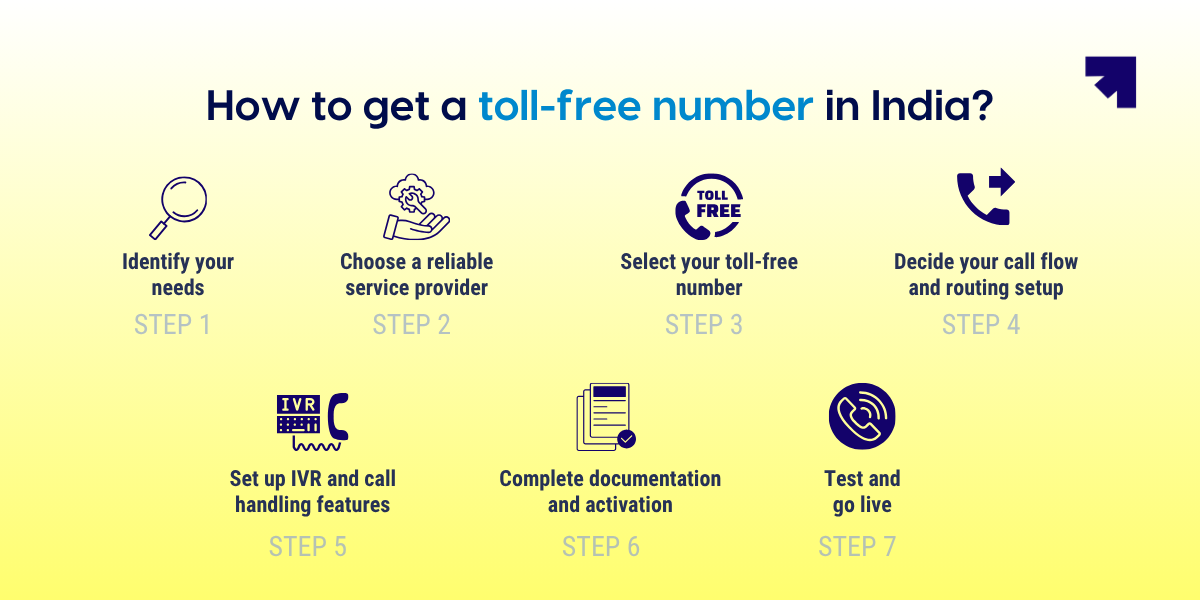
Getting a toll-free number for your business is easier than most teams expect. You do not need heavy setup or long timelines. With the right provider, you can get started in a few days. What matters more is choosing the right setup for your use case.
Here’s a step-by-step guide on how to get a toll-free number for your business:
Step 1. Identify your needs
Before choosing a service provider, determine your requirements. Think about your call volume, team size, and use case like sales, support, or both. For example, a small team may need simple routing, while a larger team may require IVR, call tracking, and integrations.
Step 2: Choose a reliable service provider
Select a reliable provider offering toll-free services in India. Popular options include Corefactors Toll Free Service, Airtel Toll-Free Services, Tata Communications, and BSNL Toll-Free Numbers. Compare their features, pricing, uptime, and support before making a decision.
Step 3: Select your toll-free number
Pick a number that is easy to remember and aligns with your brand. Some providers offer vanity numbers or patterns that improve recall. For instance, choosing a simple or repeating number sequence can make it easier for customers to dial and remember.
Step 4: Decide your call flow and routing setup
Plan how incoming calls should be handled. Define whether calls go to sales, support, or different regions, and in what order. For example, you might route calls based on language selection or send high-intent callers directly to your sales team.
Step 5: Set up IVR and call handling features
Configure your IVR menu, call queues, and other features based on your workflow. Keep it simple so callers do not get stuck navigating too many options. A basic “Press 1 for sales, Press 2 for support” setup often works better than complex menus.
Step 6: Complete documentation and activation
Submit the required KYC documents and business details to your provider. This step is mandatory in India for verification and compliance. Once approved, your number gets activated and is ready to receive calls.
Step 7: Test and go live
Before sharing the number publicly, test different call scenarios. Check routing, IVR flow, and call quality across devices. Once everything works as expected, you can start using it across your website, ads, and customer communication channels.
Advantages of getting toll-free numbers from intermediaries like Corefactors v/s directly from telecom operators
- Zero initial investment in infrastructure, setup cost, or hardware procurement.
- No need to set up an IT team to manage inbound calls effectively.
- No requirement for deep telephony knowledge like line hunting, the number of channels required to handle x call volume, and so on.
- The process is super fast, with no hassle of multiple follow-ups with telecom carriers or network providers from your end. From allotment to implementing IVR, to monitoring calls and managing uptime and downtime efficiently, everything is handled by them.
- They help you implement smart IVR on your number, which intelligently routes calls based on the caller's input with backend logic. You do not need to do anything or manage an IT team, they take care of it completely.
- They provide advanced dashboards for real-time call logs, call recordings, and call reports such as the number of answered and missed calls, and more. This helps track call-based marketing performance and enhances customer satisfaction.
- Also, most cloud telephony providers like Corefactors offer additional features like unlimited outbound calling, one-click calling, auto-dialer, PBX systems for international calls, AI-powered telephony insights, and more.
Book a Demo & Get a Toll-free Number Today
Toll-free number pricing and costs in India
The cost of a toll-free number can vary based on several factors. Here is a general breakdown:
1. Call volume and usage pattern
Your total incoming minutes shape most of your cost. More calls mean higher spend, even if rates are optimized. A support-heavy business will pay differently than a low-volume sales team.
2. Concurrent call capacity
It is not just how many calls you get, but how many happen at the same time. If multiple customers call together, you need higher channel capacity. This can impact pricing and plan selection.
3. Monthly plan or rental fee
Most providers charge a fixed monthly fee to keep the number active. This often includes a base package with limited minutes or features. Higher plans unlock more capacity and flexibility.
4. Per-minute incoming call charges
You pay for every minute a customer spends on the call. These charges may vary based on network type or provider terms. Over time, this becomes the most visible part of your bill.
5. Setup and onboarding complexity
Basic setups are usually quick and low-cost. But if you need custom IVR flows, routing logic, or integrations, costs can increase. Some providers include this, while others charge separately.
6. Number type and memorability
Simple, easy-to-recall numbers are often priced higher. These are considered premium because they improve brand recall. Standard numbers are more affordable but less distinctive.
7. Features and system depth
The more advanced your setup, the more you pay. Features like IVR, call recording, analytics, and CRM integrations may be bundled or priced separately. Your use case decides how much you actually need.
8. Flexibility and scalability of the plan
Some plans are rigid, while others scale with your growth. Flexible plans help you adjust users, minutes, and features without friction. This can save cost in the long run as your needs evolve.
Key takeaways
A toll-free number is a business phone line that customers can call for free, while the business pays for the call, making it easier to start conversations.
The benefits of toll-free numbers include removing hesitation with free calling, enabling one number across India, improving brand recall, tracking campaigns clearly, routing calls better, capturing high-intent moments, and using call data for smarter decisions.
The use cases of toll-free numbers span across support, sales, bookings, and feedback, wherever customers need quick and easy access to your business.
For growing businesses, it brings consistency across regions and channels. One number, one experience, no confusion for the customer. And most importantly, it turns conversations into opportunities. Every call is a chance to convert, support, or strengthen a relationship.
Heading 1
Heading 2
Heading 3
Heading 4
Heading 5
Heading 6
Lorem ipsum dolor sit amet, consectetur adipiscing elit, sed do eiusmod tempor incididunt ut labore et dolore magna aliqua. Ut enim ad minim veniam, quis nostrud exercitation ullamco laboris nisi ut aliquip ex ea commodo consequat. Duis aute irure dolor in reprehenderit in voluptate velit esse cillum dolore eu fugiat nulla pariatur.
Block quote
Ordered list
- Item 1
- Item 2
- Item 3
Unordered list
- Item A
- Item B
- Item C
Bold text
Emphasis
Superscript
Subscript
Frequently Asked Questions (FAQs)
1. What is a toll-free number, and how does it work?


A toll-free number is a business phone number that customers can call without being charged. The business pays for the incoming call instead. When someone dials the number, the call is routed through a provider to the right team based on your setup.
2. Why should small businesses have a toll-free number?
It makes your business look more credible from day one. Customers are more likely to call when it is free and easy. It also helps you capture more enquiries and manage calls in a structured way as you grow.
3. How to get a toll-free number in India?
Choose a reliable service provider, select your 1800 number, and pick a plan that fits your needs. Then submit your business KYC documents for verification and set up call routing or IVR. Once approved, your number gets activated and is ready to go live within a short time.
4. How much does it cost to get a toll-free number in India?
The cost of a toll-free number in India typically includes a monthly rental, per-minute incoming call charges, and sometimes a one-time setup fee. On average, plans can start from around ₹1,000 to ₹3,000 per month and go up based on features and usage.
5. What documents are required to register for a toll-free number?
You typically need basic business KYC documents for verification. This includes your business registration proof, identity proof of the authorized person, and address proof. In some cases, a signed application form or authorization letter may also be required, depending on the provider.



%20(5).png)




.png)


.png)