

Sales vs. Marketing: What’s the Difference in 2026?

Heading 1
Heading 2
Heading 3
Heading 4
Heading 5
Heading 6
Lorem ipsum dolor sit amet, consectetur adipiscing elit, sed do eiusmod tempor incididunt ut labore et dolore magna aliqua. Ut enim ad minim veniam, quis nostrud exercitation ullamco laboris nisi ut aliquip ex ea commodo consequat. Duis aute irure dolor in reprehenderit in voluptate velit esse cillum dolore eu fugiat nulla pariatur.
Block quote
Ordered list
- Item 1
- Item 2
- Item 3
Unordered list
- Item A
- Item B
- Item C
Bold text
Emphasis
Superscript
Subscript

Sales vs. Marketing: What’s the Difference in 2026?
.png)
Join us on November 6th as Mr. Yash Mishra, Product Manager, Fatakpay, reveals the precise strategies that eliminates the speed trap and guarantees a 30% conversion boost.
Sales converts prospects into customers, while marketing brings those prospects into the pipeline and builds their interest over time. Marketing creates the demand, and sales turns that demand into revenue through direct interactions and deal closure.
But if both functions ultimately drive revenue, why do so many businesses struggle to align them effectively? According to Revenue Memo, US companies lose an estimated $1 trillion annually due to poor sales and marketing coordination.
In this blog, we will break down what marketing and sales are, how they differ in approach and execution, the tools and strategies they rely on, and how they can work together to drive consistent growth.
Key takeaways:
- Marketing focuses on attracting and engaging potential customers, while sales focuses on converting them into paying customers.
- Marketing drives awareness and demand, while sales manages qualification, conversations, and deal closure.
- When marketing and sales are aligned, marketing builds a steady pipeline of qualified leads, and sales converts them efficiently through focused conversations. Together, they create a smooth, predictable path to consistent revenue growth.
What is sales?
Sales is the process of identifying potential customers, understanding their needs, and converting them into paying customers by offering the right solution. It is not just about closing deals. It is about guiding prospects from first interest to final decision through structured conversations and actions.
A well-defined sales process benefits businesses by bringing consistency and predictability. It helps teams qualify the right leads, follow up on time, and move deals forward without confusion. This improves conversion rates, helps reduce the sales cycle, and makes sales forecasting more accurate. Without a clear process, sales becomes reactive, and opportunities often slip due to missed follow-ups or lack of clarity.
For example, a SaaS company selling a CRM receives a lead from its website. The sales team qualifies the lead, understands their sales challenges, gives a tailored demo, addresses concerns, and then closes the deal. Because each step is structured, the team knows what to do next, and the customer feels confident moving forward.
Also read: What Is Presales? Definition, Difference & Strategic Steps Behind High-Performing Sales Teams
What is marketing?
Marketing is the process of attracting, engaging, and nurturing potential customers by communicating the value of your product or service. It focuses on creating awareness, generating interest, and building demand before a sales conversation even begins.
A well-defined marketing process helps businesses reach the right audience, generate qualified leads through a lead management system, and guide prospects through the early stages of the buying journey. It ensures that sales teams do not start from zero. Instead, they engage with prospects who already have some context, interest, or intent. This improves lead quality, reduces sales effort, and increases overall conversion efficiency.
For example, a SaaS company runs targeted campaigns through ads, content, and email to attract businesses looking to improve their sales process. Interested users sign up or request a demo. By the time the sales team engages, the prospect already understands the problem and solution. This makes conversations more relevant and increases the chances of closing the deal.
Also read: Inbound vs Outbound Marketing: What Works and What Doesn't?
Sales vs Marketing: 11 Key differences
Sales focuses on converting opportunities through direct interaction, while marketing focuses on creating and nurturing those opportunities at scale.
Sales strategies include prospecting, qualification, consultative selling, and deal management to move opportunities toward closure. Marketing strategies include content, campaigns, and audience targeting to attract and engage potential customers before they enter the pipeline.
| Aspect | Sales | Marketing |
|---|---|---|
| Primary focus | Converting leads into customers | Generating awareness and demand |
| Stage in funnel | Bottom of the funnel | Top and middle of the funnel |
| Objective | Close deals and generate revenue | Attract and nurture potential customers |
| Approach | Direct, one-on-one interaction | Indirect, through campaigns and content |
| Key activities | Calls, demos, negotiations, follow-ups | Ads, content marketing, email campaigns |
| Time horizon | Short to medium term | Medium to long term |
| Metrics tracked | Conversion rate, deal value, revenue | Leads, engagement, campaign performance |
| Key KPIs | Win rate, sales cycle length, revenue per rep, pipeline velocity | Lead volume, cost per lead (CPL), conversion rate, ROI, customer acquisition cost (CAC) |
| Interaction type | Personal and relationship-driven | Broad and audience-driven |
| Tools used | CRM, sales pipeline tools | Marketing automation, analytics, ad platforms |
| Outcome | Customer acquisition | Lead generation and brand positioning |
8 Steps to achieving sales and marketing alignment
Sales and marketing usually fall out of sync at one simple point. Marketing says leads are good, sales says they are not. The real issue is not effort. It is the lack of shared understanding, process, and visibility.
Alignment improves when both teams operate with clarity on who to target, how to engage, and what success looks like.
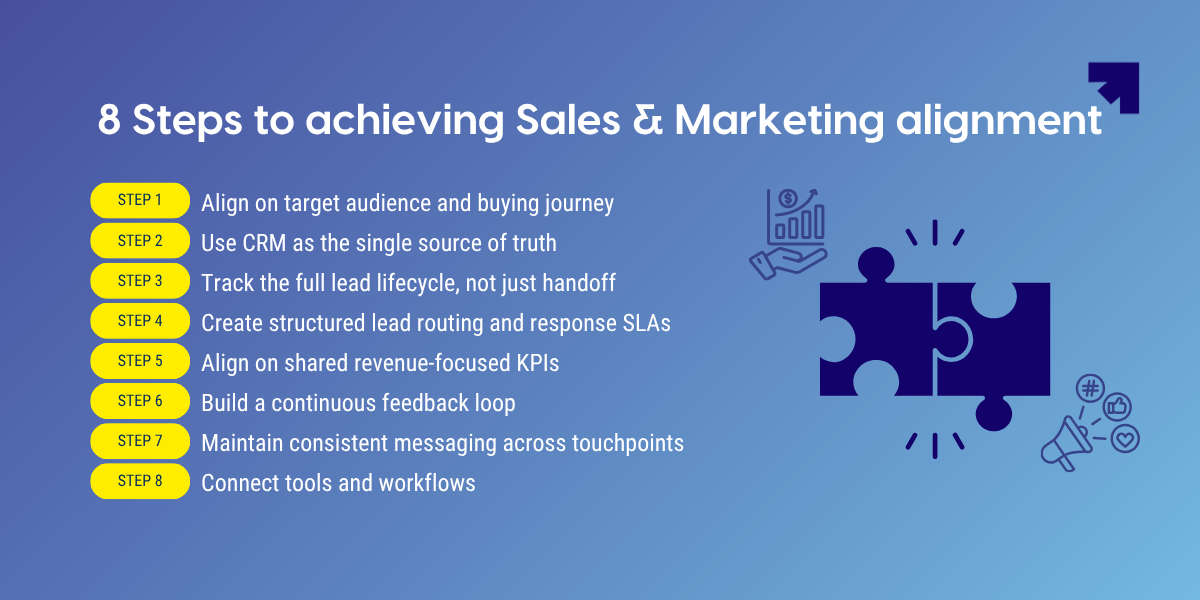
1. Align on target audience and buying journey
Start by getting very clear on who you want to sell to and how they actually make decisions.
Define your Ideal Customer Profile in detail. Go beyond industry and company size. Include pain points, urgency triggers, buying roles, and common objections. Then map the buying journey step by step, from first awareness to final decision.
For example, what makes a prospect move from curiosity to serious evaluation? What information do they need at each stage? Who is involved in the decision?
When marketing understands what creates interest and sales understands what drives decisions, both teams stop working on assumptions. Campaigns become more relevant, and sales conversations become more focused.
2. Use CRM as the single source of truth
Most alignment issues come from disconnected data and partial visibility.
A CRM brings everything into one place. Marketing can see which campaigns are generating real opportunities, not just form fills. Sales can see how a lead interacted with content, what triggered the enquiry, and what context already exists.
This removes guesswork. Instead of asking “where did this lead come from?” or “what did they see?”, both teams work with the same information.
It also creates accountability. If a lead does not convert, both teams can trace where the drop happened and why.
Also read: Top 10 Benefits of CRM Software
3. Track the full lead lifecycle, not just handoff
Alignment should not stop at the moment a lead is passed to sales.
Track the complete journey from lead capture to deal closure. Look at how many leads become qualified, how many turn into opportunities, and where they drop off.
For example, if many leads are getting stuck after the first call, the issue may not be lead quality. It could be messaging, qualification, or timing.
When both teams see the full funnel, they can fix the right problems instead of blaming each other.
4. Create structured lead routing and response SLAs
Speed and ownership play a bigger role than most teams realize.
Define how leads are assigned. Should they go by territory, product line, or rep availability? More importantly, define how quickly sales should respond.
If a high-intent lead waits too long, the opportunity weakens quickly.
Using structured routing and response timelines ensures that leads are handled consistently. It also removes confusion about who is responsible for what.
5. Align on shared revenue-focused KPIs
Misalignment often comes from how success is measured.
If marketing is measured on lead volume and sales on revenue, both teams will optimize for different outcomes. This creates friction.
Instead, define shared KPIs like pipeline generated, conversion rates, deal quality, and revenue influenced by campaigns.
When both teams are accountable for the same outcomes, their decisions start aligning naturally.
6. Build a continuous feedback loop
Sales teams hear real customer concerns every day.
They know why deals are lost, what objections come up, and what prospects actually care about. This information is extremely valuable for marketing.
Create a structured way to share this feedback regularly. It could be weekly reviews, CRM notes, or structured reports.
Marketing can use this to refine targeting, messaging, and campaigns. Over time, lead quality improves because it is based on real insights, not assumptions.
7. Maintain consistent messaging across touchpoints
Customers should not feel a disconnect between what they see and what they hear.
If marketing promises one thing and sales says something else, trust breaks quickly.
Ensure that your messaging, positioning, and value proposition remain consistent across ads, emails, landing pages, and sales conversations.
When the story is consistent, prospects move forward with more confidence.
8. Connect tools and workflows
Disconnected tools create delays, duplication, and confusion.
When marketing and sales systems are not integrated, data has to be manually transferred or interpreted. This leads to errors and missed context.
Connecting tools ensures that lead data, engagement history, and activity updates flow seamlessly. This reduces manual work and helps both teams stay aligned in real time.
When sales and marketing are aligned, the entire funnel becomes more efficient. Leads are more relevant, follow-ups are faster, conversations are more contextual, and decisions are based on real data. Instead of working in silos, both teams operate as one system focused on converting opportunities into revenue.
Essential tools that support both sales and marketing teams
Sales and marketing do not fail because of lack of effort. They struggle when tools are scattered, data is disconnected, and teams work without shared visibility.
The right tools do not just improve efficiency. They connect both teams into one revenue system where leads, conversations, and outcomes are tracked clearly.
1. CRM software (the core system for alignment)
A CRM is the most important tool for both sales and marketing. It is where everything comes together. Instead of marketing generating leads in one place and sales managing deals somewhere else, a CRM connects the full journey. From first touch to final closure, every interaction, activity, and update sits in one system.
Marketing can see which campaigns are actually driving the pipeline, not just clicks or form fills. Sales can see the full context behind every lead, including source, behavior, and past engagement. This removes guesswork and improves how both teams operate.
Modern CRMs also bring sales automation, workflow automation, lead routing, follow-up tracking, and pipeline visibility into one place. This ensures leads are handled on time, deals move consistently, and nothing slips through.
This is where platforms like Corefactors CRM stand out. It is built to connect sales, marketing, and customer interactions into one structured system. With features like automated lead capture, multi-channel communication, workflow automation, and real-time pipeline visibility, teams can move from scattered execution to a controlled revenue process.
If your goal is not just to track data but to actually improve how sales and marketing work together, it is worth exploring how Corefactors brings everything into one place.
2. Marketing automation tools
Marketing automation tools help manage campaigns, nurture leads, and track engagement at scale.
They allow teams to run email marketing campaigns, segment audiences, and automate follow-ups based on behavior. This ensures prospects stay engaged even before they speak to sales.
When connected with CRM, these tools help identify which leads are ready for sales and which need more nurturing.
3. Sales engagement tools
Sales engagement tools help teams manage outreach in a structured way.
They support email sequences, call tracking, and follow-up reminders. This ensures consistent communication and reduces manual effort.
These tools improve response rates and help sales teams stay organized while handling multiple opportunities.
4. Analytics and reporting tools
Data without insights does not help.
Analytics tools provide visibility into campaign performance, pipeline health, conversion rates, and team productivity. Both sales and marketing can use this data to identify what is working and where improvements are needed.
This shifts decision-making from assumptions to data-backed actions.
5. Collaboration and workflow tools
Sales and marketing involve constant coordination.
Collaboration tools help teams share updates, assign tasks, and track progress across campaigns and deals. This reduces miscommunication and ensures smoother execution.
When teams stay aligned internally, the customer experience also improves.
The real value is not in using more tools. It is in using the right tools together with a CRM at the center. When systems are connected, data is shared, and workflows are structured, sales and marketing stop working separately and start operating as one aligned engine driving revenue.
Conclusion
Sales and marketing are often treated as separate functions, but real growth happens when they work as one system. Marketing builds the initial interest and context, while sales turns that interest into real conversations and revenue. When both are aligned in how they target, communicate, and track opportunities, the entire journey becomes smoother and more effective.
The key is not just effort, but structure. With clear processes, shared goals, and the right tools, teams stop working in silos and start operating with visibility and control. This is what turns scattered activities into consistent outcomes and helps businesses move from unpredictable growth to a more stable, scalable revenue engine.
Heading 1
Heading 2
Heading 3
Heading 4
Heading 5
Heading 6
Lorem ipsum dolor sit amet, consectetur adipiscing elit, sed do eiusmod tempor incididunt ut labore et dolore magna aliqua. Ut enim ad minim veniam, quis nostrud exercitation ullamco laboris nisi ut aliquip ex ea commodo consequat. Duis aute irure dolor in reprehenderit in voluptate velit esse cillum dolore eu fugiat nulla pariatur.
Block quote
Ordered list
- Item 1
- Item 2
- Item 3
Unordered list
- Item A
- Item B
- Item C
Bold text
Emphasis
Superscript
Subscript
Frequently Asked Questions (FAQs)
What is sales in simple terms?


Sales is the process of identifying potential customers, understanding their needs, and converting them into paying customers through structured conversations and follow-ups.
Why is sales important for a business?
Sales is important because it directly drives revenue, converts leads into customers, and ensures consistent business growth. Without sales, demand does not translate into actual results.
What are the key steps in the sales process?
The sales process typically includes prospecting, lead capture, qualification, discovery, solution presentation, handling objections, negotiation, closing, and onboarding.
What skills are required to succeed in sales?
Key sales skills include communication, active listening, problem-solving, objection handling, time management, and the ability to understand customer needs effectively.
What are the different types of sales?
Common types of sales include B2B, B2C, inside sales, outside sales, consultative sales, transactional sales, SaaS sales, and enterprise sales, each suited for different business models and customers.

.png)
%20(9).png)
.png)




.png)


.png)