

8 Benefits of a Cloud-Based CRM in 2026

Heading 1
Heading 2
Heading 3
Heading 4
Heading 5
Heading 6
Lorem ipsum dolor sit amet, consectetur adipiscing elit, sed do eiusmod tempor incididunt ut labore et dolore magna aliqua. Ut enim ad minim veniam, quis nostrud exercitation ullamco laboris nisi ut aliquip ex ea commodo consequat. Duis aute irure dolor in reprehenderit in voluptate velit esse cillum dolore eu fugiat nulla pariatur.
Block quote
Ordered list
- Item 1
- Item 2
- Item 3
Unordered list
- Item A
- Item B
- Item C
Bold text
Emphasis
Superscript
Subscript

8 Benefits of a Cloud-Based CRM in 2026

Karthik A
Join us on November 6th as Mr. Yash Mishra, Product Manager, Fatakpay, reveals the precise strategies that eliminates the speed trap and guarantees a 30% conversion boost.
A cloud-based CRM has become the go-to choice for businesses that want speed, flexibility, and visibility without the overhead of legacy systems. As teams scale and customer expectations rise, relying on on-premise tools often creates more friction than value.
The benefits of a cloud-based CRM go beyond convenience. From faster deployment and easier integrations to lower IT dependency and real-time access to customer data, it directly impacts how sales, marketing, and support teams operate every day.
In 2026, cloud adoption is no longer a trend but the standard for CRM. According to Salesmate, nearly 87% of companies now rely on cloud-based CRM platforms to run their core operations. Compared to traditional CRMs, cloud-based platforms adapt faster, cost less to maintain, and support modern, distributed teams far better.
In this blog, we break down the key benefits of cloud-based CRM systems, how they improve business outcomes, and why more teams are making the shift.
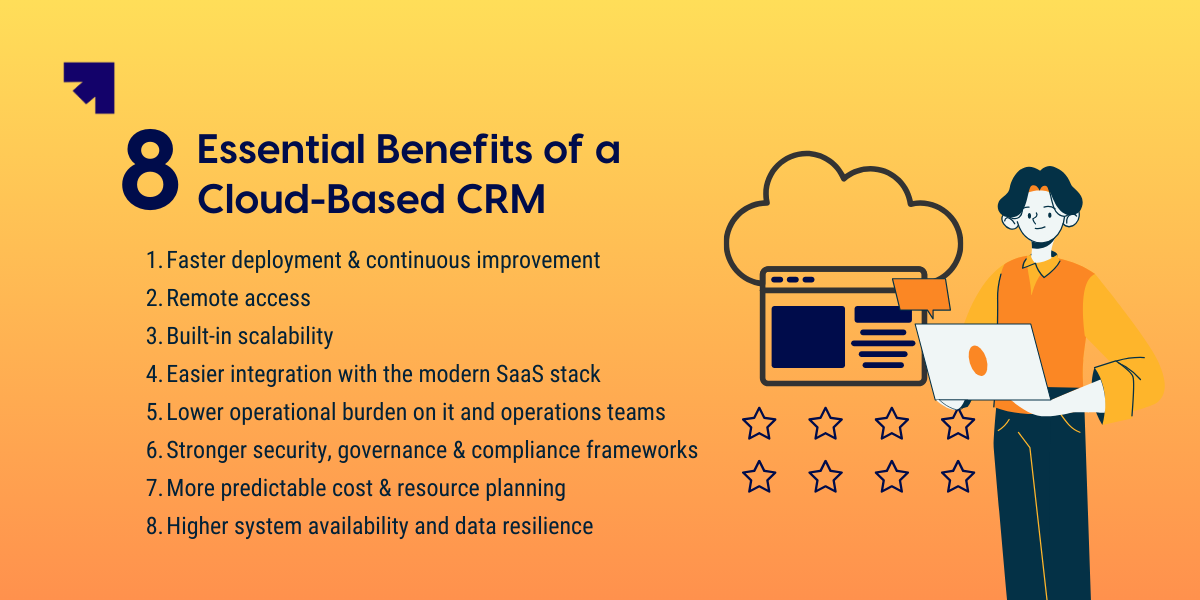
8 Essential Benefits of a Cloud-Based CRM
A cloud-based CRM does more than replace local infrastructure. It changes how quickly teams can adapt, how leaders gain visibility, and how systems evolve as the business grows.
Instead of treating CRM as a static database, cloud platforms position it as a flexible operating layer that connects channels, data, and decision-making across the revenue organization.
Here are the eight essential benefits of using a cloud-based CRM.
1. Faster deployment and continuous improvement
2. Remote access
3. Built-in scalability
4. Easier integration with the modern SaaS stack
5. Lower operational burden on it and operations teams
6. Stronger security, governance, and compliance frameworks
7. More predictable cost and resource planning
8. Higher system availability and data resilience
Let’s dive deeper into each benefit.
1. Faster Deployment and Continuous Improvement
Cloud CRMs remove the dependency on hardware, local servers, and complex installation projects. Teams can deploy the platform quickly and begin working with real data and real workflows rather than waiting for extended setup cycles. This allows organizations to move from selection to execution in a much shorter timeframe.
Because updates are delivered automatically, the system improves over time without disruptive upgrade initiatives. New features, security enhancements, and performance improvements become part of the platform as they are released, keeping the CRM aligned with changing business needs.
2. Remote Access
Modern revenue teams operate across offices, regions, and field environments. A cloud-based CRM provides consistent access to the same customer records, communication history, and workflows from any device with an internet connection.
This continuity ensures that handoffs between team members remain smooth, even when work happens across time zones or outside traditional office settings. Managers also benefit from real-time visibility into pipeline activity and performance without waiting for local data syncs or manual reports.
3. Built-In Scalability
As organizations expand into new markets or add new product lines, the demands on the CRM increase. Cloud platforms allow businesses to add users, storage, and functionality without redesigning the underlying system or investing in new infrastructure.
This scalability extends beyond capacity. Teams can adjust permissions, workflows, and automation rules as organizational complexity grows, ensuring that the CRM continues to reflect how the business operates rather than forcing process changes to fit system limitations.
4. Easier Integration with the Modern SaaS Stack
Cloud CRMs are designed to connect with marketing platforms, telephony systems, messaging channels, analytics tools, and customer support software through APIs and prebuilt integrations. This creates a unified flow of data across the entire go-to-market ecosystem.
When systems are connected, teams avoid duplicate data entry and reduce the risk of inconsistent records. This CRM integration layer also enables more advanced use cases, such as automated lead routing, cross-channel reporting, and closed-loop feedback between sales and post-sale teams.
5. Lower Operational Burden on IT and Operations Teams
With a cloud-based platform, infrastructure management is handled by the vendor. This includes server maintenance, performance optimization, backups, and system availability.
As a result, internal IT and operations teams can focus on improving CRM adoption, reporting quality, and workflow design rather than maintaining the technical foundation. This shift often leads to better alignment between system capabilities and business outcomes.
6. Stronger Security, Governance, and Compliance Frameworks
Leading cloud providers invest heavily in security certifications, encryption standards, and access control mechanisms. This helps organizations meet regulatory requirements and protect sensitive customer data without building complex security systems internally.
Cloud platforms also support governance features such as role-based access, audit logs, and data residency options. These controls make it easier to manage risk as the organization grows and operates across regions with different compliance standards.
7. More Predictable Cost and Resource Planning
Subscription pricing converts CRM investment into an operating expense rather than a capital project. This allows finance and leadership teams to forecast system costs more accurately as user counts and feature usage change.
This model also reduces the risk of overinvesting in infrastructure that may not be fully utilized. Organizations can scale their CRM footprint in line with actual growth and performance rather than upfront capacity estimates.
8. Higher System Availability and Data Resilience
Cloud platforms are typically built on distributed infrastructure with redundancy across data centers. This reduces the risk of system outages caused by local hardware failures or network disruptions.
Automated backups and recovery processes further protect customer and revenue data. This ensures that critical information remains accessible and intact even during unexpected incidents, supporting business continuity and operational stability.
Choosing a cloud-based CRM is not only a technical decision. It is a strategic choice about how adaptable, connected, and resilient your revenue systems will be as your organization evolves.
Operational Impacts of a Cloud-Based CRM
A cloud-based CRM changes how work moves through the organization on a daily basis. Instead of relying on manual handoffs and disconnected tools, teams operate inside a shared system that connects data, workflows, and decision-making across the revenue cycle. Companies can further enhance efficiency by leveraging consulting project management software, which integrates seamlessly with cloud CRMs to streamline project workflows and optimize team performance.
Below are the core operational impacts that shape execution and performance.
1. Automation That Enforces Consistency
Cloud CRMs allow teams to automate routine actions such as lead assignment, follow-up reminders, and stage-based task creation. This reduces dependence on individual memory and ensures that every opportunity moves through the same process.
Over time, this consistency improves data quality and makes performance more predictable. Managers can rely on the system to surface exceptions rather than tracking every activity manually.
2. AI-Powered Insights for Better Decisions
Modern cloud platforms use AI to analyze patterns across deals, conversations, and customer behavior. This can surface risks such as stalled opportunities, low-quality leads, or declining engagement before they become visible in reports.
For leaders, this means decisions are guided by signals rather than lagging indicators. Teams can focus effort where it has the highest impact instead of reacting after performance drops.
3. Faster Collaboration Across Teams
Because data lives in one shared system, marketing, sales, and post-sale teams work from the same customer record. Notes, conversations, and status changes become visible across departments in real time.
This reduces handoff errors and keeps customer context intact as ownership changes. It also shortens response times and improves the overall experience for prospects and customers.
4. Real-Time Visibility Into Pipeline and Performance
Cloud CRMs update dashboards and reports as activity happens. Managers can see pipeline movement, deal aging, and team performance without waiting for manual updates or end-of-week reports.
This visibility supports quicker course correction. Issues can be addressed while deals are still active rather than after targets are missed.
5. Scalable Process Control as Teams Grow
As organizations add users and regions, cloud platforms make it easier to apply consistent rules across the system. Permissions, workflows, and automation can be adjusted centrally rather than managed team by team.
This keeps execution aligned even as complexity increases. The system becomes a way to carry standards forward as the organization expands.
The operational value of a cloud-based CRM lies in how it turns daily work into structured, visible, and measurable processes that improve over time rather than relying on individual effort alone.
Bottom line?
Cloud solutions are important because they let teams move faster, scale easier, and stay connected across every customer touchpoint. A cloud-based CRM helps centralize data, automate workflows, and give leaders real-time visibility into how revenue moves through the business.
The benefits of a cloud CRM include faster deployment, remote access, built-in scalability, easy integrations, reduced IT load, strong security, predictable costs, and high availability. By choosing a CRM like Corefactors, teams can unify communication, automation, and governance inside one lead-to-revenue system.
Want to see how this would work for your team? Book a quick demo to explore how a cloud CRM can support your growth model.
Heading 1
Heading 2
Heading 3
Heading 4
Heading 5
Heading 6
Lorem ipsum dolor sit amet, consectetur adipiscing elit, sed do eiusmod tempor incididunt ut labore et dolore magna aliqua. Ut enim ad minim veniam, quis nostrud exercitation ullamco laboris nisi ut aliquip ex ea commodo consequat. Duis aute irure dolor in reprehenderit in voluptate velit esse cillum dolore eu fugiat nulla pariatur.
Block quote
Ordered list
- Item 1
- Item 2
- Item 3
Unordered list
- Item A
- Item B
- Item C
Bold text
Emphasis
Superscript
Subscript
Frequently Asked Questions (FAQs)
What is a cloud-based CRM?


A cloud-based CRM is software hosted online instead of on your local servers. Your team can access customer data, pipelines, and reports from any device. It reduces IT effort, scales easily, and updates automatically as you grow.
What are the benefits of cloud CRM?
Cloud CRM offers significant advantages over traditional on-premise systems, including faster deployment, remote access, built-in scalability, easy integrations, reduced IT load, strong security, predictable costs, and high availability.
How does a cloud CRM work?
A cloud CRM runs on secure online servers instead of your local systems. Your team logs in through a browser or app from any location. Data updates in real time, and the provider handles maintenance and upgrades.
Is a cloud CRM secure for customer data?
Most platforms use encryption, role based access, and regular backups. They also follow compliance standards and run constant security monitoring. This often exceeds the protection level of in house systems.
Can a cloud CRM reduce operational costs?
It removes server maintenance and cuts internal IT workload. It offers predictable pricing with simple user based plans. You pay for usage instead of long term infrastructure.


.png)
.png)




.png)


.png)