

CRM Adoption Trends for 2026: The Future of CRM

Heading 1
Heading 2
Heading 3
Heading 4
Heading 5
Heading 6
Lorem ipsum dolor sit amet, consectetur adipiscing elit, sed do eiusmod tempor incididunt ut labore et dolore magna aliqua. Ut enim ad minim veniam, quis nostrud exercitation ullamco laboris nisi ut aliquip ex ea commodo consequat. Duis aute irure dolor in reprehenderit in voluptate velit esse cillum dolore eu fugiat nulla pariatur.
Block quote
Ordered list
- Item 1
- Item 2
- Item 3
Unordered list
- Item A
- Item B
- Item C
Bold text
Emphasis
Superscript
Subscript

CRM Adoption Trends for 2026: The Future of CRM
.png)
Karthik A
Join us on November 6th as Mr. Yash Mishra, Product Manager, Fatakpay, reveals the precise strategies that eliminates the speed trap and guarantees a 30% conversion boost.
Why are teams still struggling with CRM adoption even after investing so much in it? The real reason is simple. CRM itself is changing. Today’s CRM adoption trends show a clear shift from systems that just store data to ones that actually help teams take action and move deals forward.
Earlier, CRM was mainly for tracking. Now, it is becoming a system that helps you manage pipelines, follow up at the right time, and make better decisions without overthinking. The CRM market is expected to reach $126.17 billion in 2026, with 91% of companies already using CRM to manage their sales and customer data.
As these CRM adoption trends continue to grow, one thing is clear. Teams that adapt are moving faster and closing better. The ones that don’t are still stuck updating CRM after the work is already done.
In this blog, we will explore CRM adoption trends, the key drivers behind them, common challenges, and practical ways to improve adoption. Let’s dive in.
What is CRM adoption?
CRM adoption is the degree to which your teams actually use the CRM in their daily work. It goes beyond logins and dashboards. It reflects consistent, accurate, and process-driven usage across sales, marketing, and customer-facing teams.
At its core, CRM adoption answers a simple question: “Is work happening inside the CRM, or outside it?”
It typically comes down to three key dimensions:
- Frequency of usage – how regularly users log in and engage
- Data discipline – whether records are complete, accurate, and up to date
- Workflow integration – whether everyday tasks happen inside the CRM
When these three work together, adoption stays strong. When even one breaks, the system starts losing value quickly.
CRM Adoption: High Performers vs Struggling Teams
High CRM adoption
High CRM adoption means your CRM is part of how work gets done. Teams do not just use it. They depend on it.
Here’s what that looks like in practice:
- Sales reps update deals in real time, not after reminders
- Follow-ups, tasks, and activities are tracked inside the system
- Data is complete, clean, and reliable across records
- Managers rely on CRM dashboards instead of chasing updates
- Forecasts are based on actual, up-to-date pipeline data
- Sales, marketing, and support share clear visibility
In this state, the CRM becomes a system of action, not just storage.
Also read: Top 10 Benefits of CRM Software in 2026
Low CRM adoption
Low CRM adoption means the CRM exists, but real work happens elsewhere. Teams treat it as a reporting tool, not a working tool. According to Wave Connect, the average CRM user adoption rate among sales professionals sits at 72% - meaning 28% of reps with CRM access aren't consistently using it.
Here’s how it usually shows up:
- CRM updates happen only before review meetings
- Sales reps maintain personal spreadsheets, notes, or WhatsApp threads
- Deal stages are outdated, inconsistent, or inaccurate
- Data fields are incomplete or filled just for the sake of it
- Managers rely on calls, messages, or manual follow-ups for updates
- Reports fail to reflect the actual state of the pipeline
In this case, the CRM becomes a system of record, not a system teams trust. Over time, this leads to poor visibility, weak forecasts, and missed revenue opportunities.
CRM Adoption Trends in 2026
CRM adoption is no longer about implementing a tool. That phase is done. What is changing now is more fundamental. CRM is becoming the system that actually runs revenue.
It is shifting from storing data to driving actions. From dashboards to decisions. From tracking to execution. So the real question is not, “Do you have a CRM?” It is, “Is your CRM doing the work, or are your teams still doing it?” The trends below show how that shift is playing out.
CRM trend 1: Agentic AI is replacing manual execution layers
For years, CRM depended on human discipline. Reps had to update data, trigger workflows, and remember follow-ups. Let’s be honest. That rarely happened consistently. With AI-powered sales engagement, teams are closing faster and building stronger pipelines. MindStudio found that sales cycles can shrink by 40%, while qualified pipelines can grow by 215%.
Now that dependency is reducing.
- Leads are qualified automatically using intent signals
- Follow-ups are triggered across channels without manual input
- Data is cleaned and enriched continuously in the background
So what changes here? Execution no longer depends on whether someone updates the CRM.
The system keeps moving even when humans don’t. This is a big deal. It removes one of the biggest reasons CRM fails, which is inconsistent usage.
CRM trend 2: CRM shifts from system of record to system of action
Traditionally, CRM stored information. Teams reviewed it and decided what to do next. That model was slow and reactive. Now ask yourself this. Why wait for a pipeline review to take action?
Modern CRM systems read data in real time.
They trigger actions the moment something needs attention.
- A deal slows down → follow-up gets triggered
- A lead shows intent → outreach starts automatically
- A customer shows risk → intervention kicks in
The shift is simple but powerful. From “look at data and act” to “system acts based on data.” And this is changing how CRM is evaluated. Not by features, but by how much work it actually completes.
CRM trend 3: Hyper-personalization becomes always-on, not planned
Personalization used to mean segments and templates. Now it is continuous and behavior-driven. According to Forbes, 81% of customers prefer companies that offer personalized experiences, while 70% say it is important that businesses understand their history, including past purchases, buying patterns, and support interactions.
Think about this. Why send a campaign later when intent is happening now?
- Outreach triggers instantly after key actions
- Messaging adapts based on recent behavior
- CRM suggests next-best actions based on probability
This is not campaign-based anymore. It is a real-time response to customer signals. Every interaction becomes more relevant. And that directly impacts conversion and retention.
CRM trend 4: Predictive analytics moves from reports to decisions
Predictive analytics has existed for a while. But earlier, it mostly lived in reports. Teams would review insights and then act. That gap slowed everything down.
Now predictions are built into execution.
- Deal scoring is based on real engagement signals
- Churn risks are identified early and acted on
- Forecasts update dynamically based on pipeline activity
So instead of asking, “What happened?” Teams now ask, “What should we do next?” That is a big shift.
CRM moves from hindsight to foresight.
Also read: AI in Predictive Sales Analytics: Unlocking Future Trends
CRM trend 5: Industry-specific CRM reduces friction from day one
Generic CRM systems often need heavy customization. That slows adoption and creates dependency on tech teams.
Now imagine starting with a CRM that already fits your business.
- Healthcare CRMs include compliance and patient workflows
- Real estate CRMs manage property and site visits natively
- Manufacturing CRMs handle dealers and partners out of the box
Less setup. Less friction. Faster adoption. Instead of adapting your business to CRM,
the CRM adapts to how you already work.
CRM trend 6: Low-code evolves into AI-driven system design
Low-code made CRM easier to configure. Now AI is taking it one step further. Instead of building workflows manually, you describe what you want.
And the system builds it.
- Teams create workflows using plain language
- Changes happen in hours, not weeks
- Iteration becomes continuous, not occasional
So what does this mean in practice? CRM is no longer static. It evolves as fast as your business does.
CRM trend 7: Omnichannel CRM becomes the baseline
Customers do not stick to one channel. They move between email, calls, chat, and more. Now think about this. What happens when your teams don’t share context? Fragmented experience. Missed signals. Lost deals.
Modern CRM solves this by unifying everything.
- One customer profile across all touchpoints
- Sales, support, and marketing see the same context
- Conversations continue seamlessly across channels
At this point, omnichannel is not a differentiator. It is expected.
CRM trend 8: Revenue operations becomes the backbone of CRM usage
As CRM becomes central, alignment becomes critical. Without alignment, CRM turns messy quickly.
Different teams define things differently and workflows break. That is where Revenue operations (RevOps) comes in.
- Shared definitions across marketing, sales, and success
- Automated handoffs based on real signals
- Early visibility into stalled deals and missed follow-ups
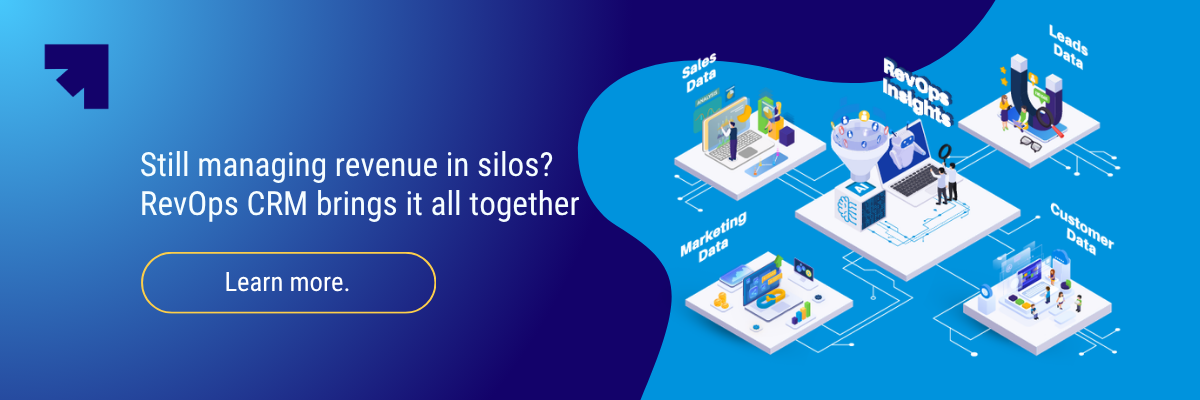
So instead of teams working in silos, CRM becomes the shared system that connects everything.
CRM trend 9: Mobile CRM becomes the primary interface
Mobile CRM users are 150% more likely to exceed their sales quotas compared to non-mobile users. CRM is no longer a desktop-first system. Work does not happen at a desk anymore. Reps are on calls, in meetings, and on the move. So ask this. Will they wait to update the CRM later?
Probably not. That is why mobile is becoming the primary interface.
- Full pipeline access on mobile
- Voice-based updates after meetings
- Offline syncing for uninterrupted work
- Location-based tracking for field activities
CRM becomes part of the workflow. Not something updated at the end of the day.
Struggling with CRM adoption?
See how teams using Corefactors close 2x faster.
[Start free trial]
Key market-level shifts driving this evolution
These future trends are built on strong foundations already visible today. A few core shifts explain why CRM adoption continues to accelerate globally.
1. CRM remains the largest enterprise software segment
CRM continues to lead enterprise software investments worldwide. It sits at the center of customer data, pipeline visibility, and revenue planning.
2. From sales tool to revenue ecosystem
CRM is no longer limited to sales teams. It now supports the entire customer lifecycle, from first touch to long-term retention.
3. AI and automation are accelerating adoption
Modern CRMs are becoming proactive systems. Automation reduces manual work, while AI improves decision-making. According to DemandSage, around 83% of companies are already using AI features within their CRM workflows, with 65% of businesses reporting better customer engagement due to AI-powered virtual sales assistants.
4. Mobile and remote-first usage is now standard
CRM is no longer tied to office setups. Teams update deals, track activities, and collaborate from anywhere. Together, these shifts point to a clear direction: CRM is becoming the operational backbone for modern revenue teams.
Adoption by industry
CRM adoption maturity varies based on industry complexity and needs.
| Industry | Adoption Maturity | Key Use Case | Trend Direction |
|---|---|---|---|
| SaaS | Very High | Pipeline and lifecycle tracking | Mature |
| BFSI | High | Compliance and customer data | Growing |
| Healthcare | Medium | Patient engagement | Emerging |
| Retail | High | Omnichannel personalization | Expanding |
| Manufacturing | Medium | Dealer and partner management | Catching up |
SaaS and retail lead with deeply embedded CRM usage. BFSI follows with strong adoption driven by compliance and data control. Healthcare and manufacturing are catching up steadily.
Adoption by company size
CRM adoption also varies significantly by company size and maturity.
| Segment | Adoption Trend | Key Challenge |
|---|---|---|
| SMBs | Rapid adoption (cloud CRM) | Cost and onboarding |
| Mid-market | Structured adoption | Integration complexity |
| Enterprises | Mature but fragmented | Data silos |
SMBs are adopting CRM faster due to accessibility and ease of use. Mid-market companies focus on building structured, scalable processes. Enterprises already have CRM systems in place, but adoption is often fragmented across teams and tools.
CRM adoption is no longer about implementation alone. It is about how deeply the system connects teams and workflows. Companies with high adoption treat CRM as a central system. Others still use it as a reporting layer. That difference directly impacts visibility, efficiency, and growth.
Also read: 10 Best CRM Software in 2026
Key drivers of CRM adoption
CRM adoption is not increasing by chance. It is being pushed by larger shifts in how businesses operate today.
#1 Digital transformation acceleration
Digital transformation has pushed companies to simplify their tech stack. Instead of using multiple disconnected tools, businesses are moving toward centralized platforms.
This is where CRM naturally fits in. A modern CRM is no longer just a place to store contacts. It acts as a core system that connects data, teams, and processes.
In this setup, CRM becomes:
- A single source of truth for all customer data
- A revenue intelligence layer for tracking and analyzing pipeline
- A customer lifecycle engine that manages every stage
This consolidation reduces data silos and improves visibility. It also makes decision-making faster and more reliable. As digital transformation continues, CRM adoption becomes a necessity, not a choice.
#2 AI and automation integration
AI is fundamentally changing how CRM systems are used. It is shifting CRM from manual data entry to intelligent decision support.
Modern CRM platforms now include:
- Predictive lead scoring
- Automated workflows
- AI-driven sales forecasting
These features reduce manual effort and improve consistency. They also make CRM more valuable for end users, directly driving adoption. Trend insight: CRM is evolving into an AI-powered decision engine, not just a database.
Also read: 7 Ways AI-Powered CRM Software Can Maximize Efficiency and Boost Sales
#3 Remote and hybrid sales models
The shift to remote and hybrid work has made CRM essential. Teams are no longer working from the same office or in real time.
CRM helps solve this by acting as a shared workspace. It enables:
- Seamless collaboration
- Async communication
- Real-time pipeline visibility
This shift has made CRM a daily working tool, not just a reporting system.
Top CRM adoption challenges
CRM adoption challenges rarely come from the software itself. They usually stem from gaps in usage, data discipline, and team alignment. When teams don’t consistently update the CRM, data quickly becomes unreliable. This leads to poor visibility, missed follow-ups, and decisions based on assumptions.
Over time, the CRM shifts from being a growth driver to just another tool in the stack. Here’s a tabular breakdown of the most common CRM adoption challenges, their impact, and how to fix them effectively:
| Issue | Severity | Impact | Fix |
|---|---|---|---|
| Low user adoption | Critical | CRM becomes irrelevant | Training and incentives |
| Poor data quality | High | Bad decisions and insights | Data governance |
| Tool complexity | High | Drop in daily usage | UX simplification |
| Lack of integration | Critical | Data silos | API-first integration |
| No leadership buy-in | Critical | Adoption stalls | Executive sponsorship |
How to increase CRM adoption: 6 Steps
Improving CRM adoption is not about forcing usage. It is about making CRM the easiest way for teams to get their work done. When the system feels like extra effort, people avoid it. When it helps them move faster and stay organized, usage becomes natural.
Despite the surge in AI adoption, 55% of CRM implementations still fail to meet objectives. Most failures are driven by data entry friction and low user adoption, as highlighted by Wave Connect.
Here is a practical, step-by-step way to make that happen.
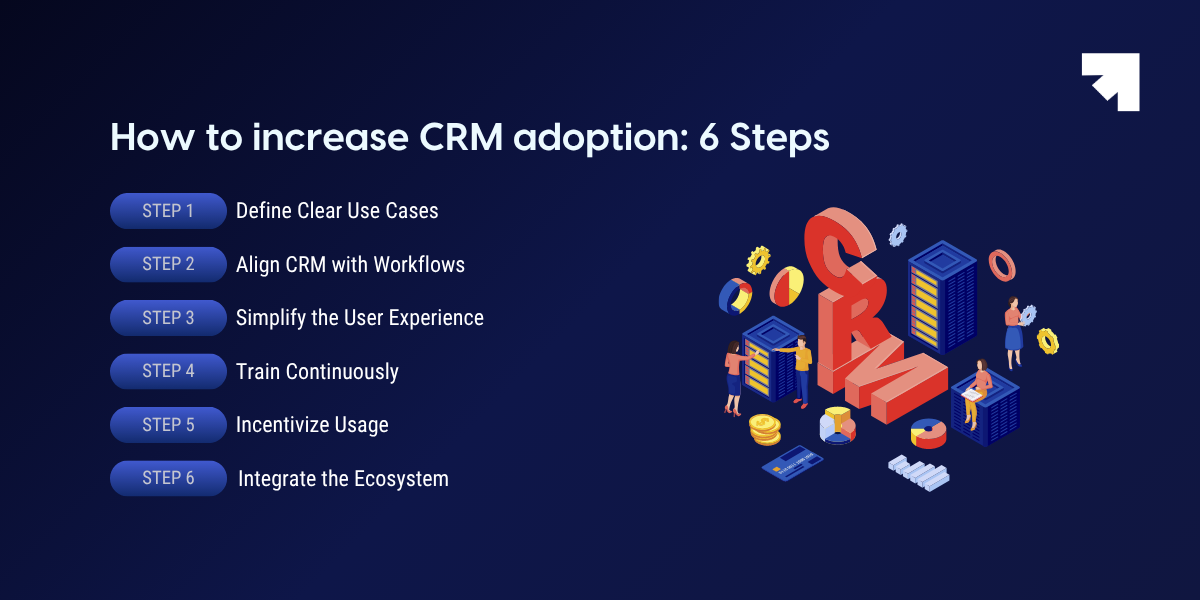
Step 1: Define Clear Use Cases
Start with clarity. Teams need to know exactly why the CRM exists and how it helps them. Without this, usage becomes inconsistent and data quality drops.
Focus on a few core use cases that directly impact revenue. This typically includes sales pipeline tracking, marketing attribution, and customer lifecycle management. When these are clearly defined, users understand what to update, when to update it, and why it matters.
Step 2: Align CRM with Workflows
CRM should be where work happens, not where it gets recorded later. If reps complete tasks outside the system and update it afterward, adoption will always be weak.
Instead, embed CRM into daily workflows. Deals should be managed inside the system, follow-ups should be triggered from it, and activities should be logged as part of execution. When CRM becomes part of the process, not an extra step, usage becomes consistent.
Also read: 9 Reasons You Need Workflow Automation for Your Small Business
Step 3: Simplify the User Experience
Complexity is one of the biggest reasons CRM adoption fails. Too many fields, unnecessary steps, and cluttered interfaces slow users down and create resistance.
Simplify wherever possible. Remove fields that do not drive decisions. Automate data entry using integrations or AI. Use dashboards to replace manual reporting. The goal is to make CRM faster and easier than any alternative.
Step 4: Train Continuously
CRM training should not stop after onboarding. As processes evolve, users need ongoing guidance to stay aligned and use the system effectively.
Provide regular refreshers, share practical use cases, and reinforce usage through managers. When users understand how CRM helps them perform better, they are more likely to use it consistently.
Step 5: Incentivize Usage
Adoption improves when it is tied to outcomes. If CRM usage is optional, it becomes inconsistent. If it is linked to performance, it becomes a habit.
Align CRM with key metrics such as deal updates, follow-up consistency, and pipeline accuracy. In some cases, connect it to incentives or compensation. This ensures that usage is not just encouraged but expected.
Step 6: Integrate the Ecosystem
A disconnected CRM creates more work. Users end up switching between tools, which breaks flow and reduces adoption.
Integrate CRM with marketing platforms, support systems, and analytics tools. This allows data to flow automatically and keeps everything in one place. When CRM becomes the central hub, teams rely on it naturally.
CRM adoption improves when the system is useful, simple, and embedded into daily work. It drops when it feels like extra effort. The goal is not to make people use CRM, but to make it the easiest way to do their job.
Bottom line?
CRM adoption is defined by how consistently teams use the system in their daily workflows, measured through usage frequency, data quality, and workflow integration rather than just logins or activity.
CRM adoption trends in 2026 show a clear shift toward execution-driven systems powered by AI, automation, real-time decision-making, and omnichannel data, moving CRM from a system of record to a system of action.
Key drivers of CRM adoption include digital transformation, AI and automation integration, and the rise of remote and hybrid work, all of which make CRM the central system for managing revenue and customer relationships.
Improving CRM adoption requires making the system the easiest place to do work, not an additional task, by aligning it with daily processes and tying usage to real outcomes.

Heading 1
Heading 2
Heading 3
Heading 4
Heading 5
Heading 6
Lorem ipsum dolor sit amet, consectetur adipiscing elit, sed do eiusmod tempor incididunt ut labore et dolore magna aliqua. Ut enim ad minim veniam, quis nostrud exercitation ullamco laboris nisi ut aliquip ex ea commodo consequat. Duis aute irure dolor in reprehenderit in voluptate velit esse cillum dolore eu fugiat nulla pariatur.
Block quote
Ordered list
- Item 1
- Item 2
- Item 3
Unordered list
- Item A
- Item B
- Item C
Bold text
Emphasis
Superscript
Subscript
Frequently Asked Questions (FAQs)
1. What are CRM adoption trends in 2026?


CRM adoption in 2026 is driven by simplicity, automation, and AI. Teams prefer systems that reduce manual work. Mobile-first usage is now standard. AI handles follow-ups, data entry, and insights. Adoption improves when CRM fits daily workflows, not the other way around.
2. What is the ROI of CRM software in 2026?
CRM ROI comes from better conversion, faster deal cycles, and improved visibility. Teams close more deals with structured pipelines. Automation reduces time spent on admin work. Most businesses see higher revenue efficiency when adoption is consistent.
3. Why do CRM adoption rates still remain low?
Low adoption usually comes from poor usability and extra manual effort. If reps see CRM as reporting, they avoid it. Lack of training and unclear processes also hurt usage. Adoption increases when CRM helps reps close deals faster.
4. How is AI changing CRM adoption?
AI is removing friction from CRM usage. It automates data entry, suggests next actions, and predicts deal outcomes. This reduces dependency on manual updates. As effort drops, adoption naturally improves.
5. How can companies improve CRM adoption in 2026?
Focus on ease of use and clear workflows. Reduce manual data entry wherever possible. Train teams based on real use cases. Align CRM usage with daily sales activities. Adoption improves when CRM becomes part of how work gets done.






.png)


.png)